What Does the Bible Say About Loneliness? Key Verses & Insights (2026)
The Bible addresses loneliness from Genesis to Revelation. Explore key verses, biblical figures who felt alone, and what 2026 research reveals about faith and connection.

Reading through the post to find the natural fit.
The "How Does the New Testament Reframe Loneliness?" section opens with "The New Testament offers a structural answer to loneliness" — a reader who wants to understand what the New Testament is before diving into this section would naturally follow a link to the testaments guide. That's the cleanest anchor in the post.
No second fit clears the bar. The other testament references are either already linked, use only "Old" / "New" as table cell labels (poor anchor text), or appear inside phrases already carrying their own contextual weight.
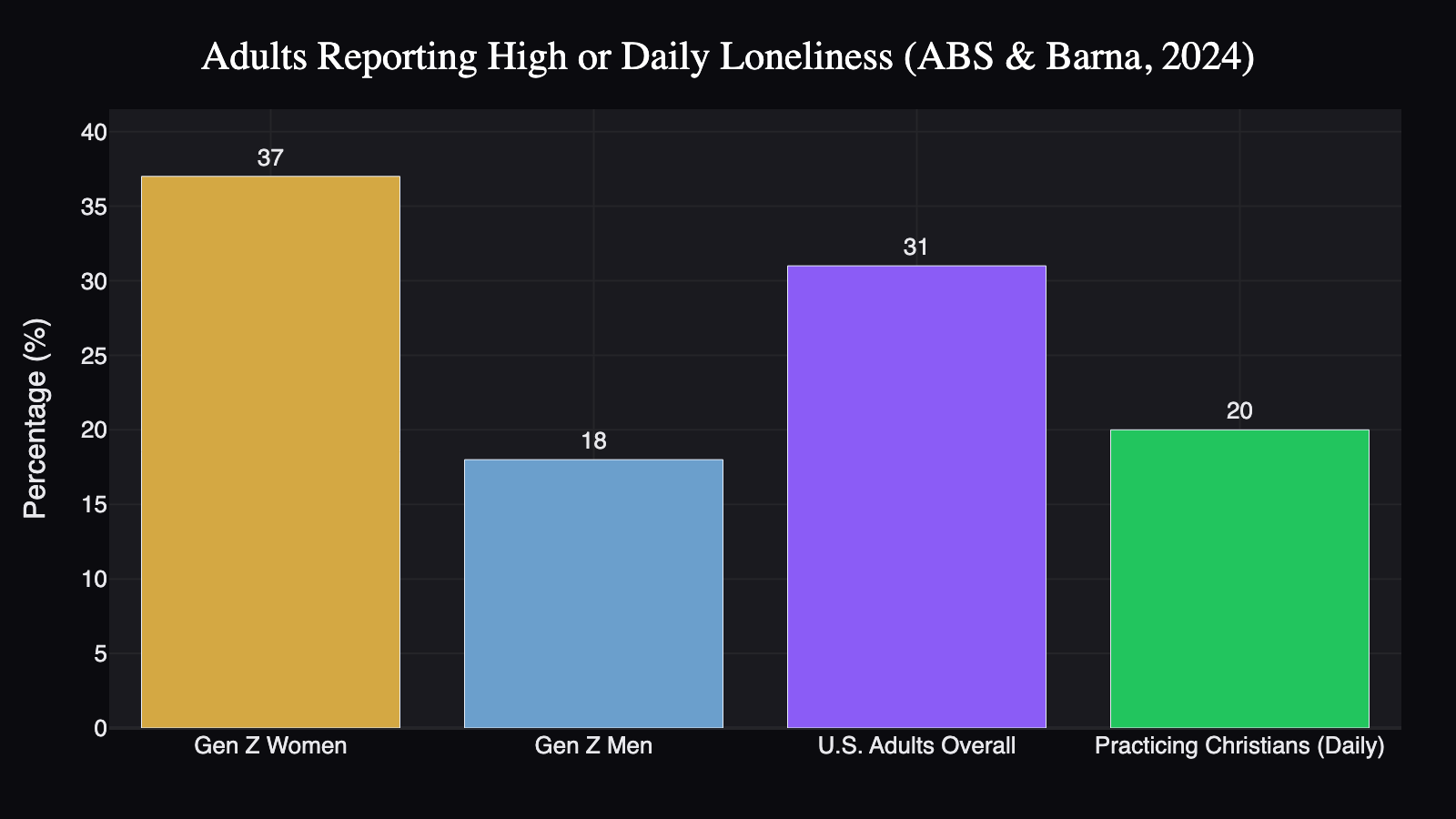
Nearly 3 in 4 Americans report moderate-to-high levels of loneliness, according to the American Bible Society's State of the Bible 2024. Among younger adults, the numbers are sharper: Gen Z women report high loneliness at twice the rate of Gen Z men. And the problem doesn't dissolve inside church walls -- Barna Group research finds that 1 in 5 practicing Christians still feels lonely daily.
What does the Bible actually say about this? Not in a surface-level "here are 10 verses to feel better" sense -- but what does the arc of Scripture say, from Genesis to Revelation, about human isolation?
This guide covers the key verses, the biblical figures who lived through loneliness, and what 2026 research reveals about faith and connection. If you want to see how these passages relate across the whole canon, ScriptureVerse maps 340,000+ cross-references between all 31,102 verses -- exploring loneliness as a thread through Scripture becomes a different experience when you can watch the network form in real time.
What Does the Bible Say About Loneliness?
The Bible treats loneliness as a universal human experience, not a sign of spiritual failure, and consistently answers it with God's promise of presence rather than an explanation.
The scriptural arc moves from "it is not good for man to be alone" in Genesis 2 to "God himself will be with them" in Revelation 21. Between those bookends: lament psalms, abandoned prophets, apostles writing from prison. Scripture doesn't minimize the feeling or rush past it. It names loneliness directly and holds it honestly before moving to the theological response.
Several consistent patterns run through the biblical treatment of loneliness:
- God identifies and names human solitude before humans articulate it (Genesis 2:18)
- Faithful, obedient people experience deep loneliness -- not just those who have failed
- The Bible's primary answer is presence, not solution
- Community appears as a structural response, not just personal comfort
Where Does Loneliness Begin in Scripture?
Loneliness enters Scripture in Genesis 2:18, when God observes that human solitude is the first thing in creation explicitly described as "not good."
That statement predates the Fall, which means relational incompleteness wasn't introduced by sin but was built in as something pointing toward community. Genesis 3 deepens the problem: shame drives humanity into hiding, fracturing both the relationship with God and with each other. Most theologians, across Catholic, Protestant, and Orthodox traditions, read this rupture as the origin of the isolation humans carry.
What Are the Key Bible Verses About Loneliness?
The most-cited verses on loneliness cluster around themes of divine nearness, lament, and the promise that God does not abandon his people.
The table below draws from community-ranked data at OpenBible.info, which aggregates reader votes on which passages practitioners actually reach for -- a useful signal about what the text means to people in real moments of isolation, not just what scholars cite:
| Verse | Core Promise | Testament |
|---|---|---|
| Psalm 68:6 | "God sets the lonely in families" | Old |
| Psalm 34:18 | He is close to the brokenhearted | Old |
| Isaiah 41:10 | "Do not fear, for I am with you" | Old |
| Hebrews 13:5 | "Never will I leave you nor forsake you" | New |
| John 14:18 | "I will not leave you as orphans" | New |
| Matthew 11:28 | "Come to me, all who are weary" | New |
| Psalm 25:16 | "Turn to me; I am lonely and afflicted" | Old |
These passages aren't isolated -- they echo each other across centuries. Trace the cross-references from Isaiah 41:10 and you'll find connections to Deuteronomy 31:6, Romans 8:31, and Joshua 1:9: a chain of divine accompaniment running from the Mosaic covenant through Paul's letters.
Who in the Bible Actually Felt Lonely?
The Bible's most honest portraits of loneliness come from figures who were deeply faithful: Elijah, David, Paul, and Jesus himself.
Three cases stand out as the clearest biblical case studies:
- Elijah (1 Kings 19): After his greatest victory over the prophets of Baal, Elijah collapsed under a juniper tree and asked God to let him die. He wasn't in sin -- he was exhausted and alone. God's response: food, rest, and then conversation. Presence before explanation.
- David (Psalm 25:16): "Turn to me and be gracious to me, for I am lonely and afflicted." David doesn't theologize around the feeling. He names it in plain language and brings it directly into prayer -- giving every reader vocabulary for the same move.
- Paul (2 Timothy 4:16): Writing from prison, Paul records: "At my first defense, no one came to my support, but everyone deserted me." He adds that the Lord stood at his side. The pattern mirrors Elijah's: human abandonment met by divine presence.
"My God, my God, why have you forsaken me?" -- Psalm 22:1 / Matthew 27:46
Scholars and theologians across traditions point to this moment -- Jesus quoting Psalm 22 from the cross -- as Scripture's most radical engagement with loneliness. God didn't observe human abandonment from a distance. He entered it.
What Does Research Show About Faith and Loneliness in 2026?
Research from the American Bible Society shows that Scripture-engaged Americans are 50% less likely than Bible-disengaged Americans to report high levels of loneliness.
That's a meaningful correlation, but Barna Group data complicates the picture. Church attendance doesn't eliminate loneliness as much as you might expect: 1 in 5 practicing Christians reports daily loneliness, and lonely churchgoers describe more severe experiences than their unchurched peers. Forty-eight percent of lonely churchgoing adults call their loneliness intense to unbearable, compared to 39% among non-churchgoers.
One especially surprising finding from the American Bible Society's research: the inability to forgive correlates with the highest loneliness levels in their entire dataset. That connection -- forgiveness as a loneliness factor, not just a relational virtue -- appears in the data and aligns with how Scripture treats the two topics. Matthew 6:14-15 and Colossians 3:13 treat forgiveness as essential to the relational fabric the Bible prescribes against isolation.
How Does the New Testament Reframe Loneliness?
The New Testament offers a structural answer to loneliness: the church as embodied community, and the Holy Spirit as the permanent companion Jesus promised.
In John 14:18, Jesus tells his disciples they won't be left as "orphans" -- the Greek word orphanos described anyone without a patron or protector, vulnerable and unconnected. The promise wasn't abstract: a new relational reality anchored in the Spirit's presence.
Paul builds the communal case through 1 Corinthians 12: the church is a body where "if one part suffers, every part suffers" (verse 26). Ecclesiastes 4:9-10 -- "two are better than one" -- functions as the structural rationale for community, not just a motivational sentiment. Romans 8:38-39 provides the theological ceiling: nothing -- death, life, angels, height, or depth -- can separate believers from the love of God.
The New Testament doesn't deny that you may feel alone. It argues that you are never, in any definitive sense, without witness.
How Should You Study Bible Verses About Loneliness?
A practical sequence for loneliness study moves from lament Psalms through narrative examples, then prophetic promises, communal passages, and finally prayer rooted in the biblical text itself.
- Start with a lament psalm. Psalm 25, 34, or 68 -- read it aloud and notice how directly the writer names the feeling before moving to trust. The order matters.
- Follow the cross-references. Pick one verse, like Isaiah 41:10, and trace where it echoes across the canon. ScriptureVerse's galaxy view makes those connections visible immediately.
- Read a biblical narrative. Elijah in 1 Kings 19 or Paul in 2 Timothy 4 -- see how a real person moved through loneliness, not just what God promised.
- Add a communal passage. Ecclesiastes 4:9-10, Acts 2, or 1 Corinthians 12 pairs the individual experience with Scripture's structural answer.
- Pray the verse. Psalm 25:16 is already a prayer. Using biblical language rather than inventing your own draws on a practice shared across every Christian tradition.
For a deeper look at how cross-references work as a study tool, What Are Bible Cross-References? A Visual Guide to Scripture's Hidden Network is a useful starting point. The Bible verses about loneliness topic page on ScriptureVerse also aggregates the passages that matter most to this topic in one place.
Loneliness in Scripture rarely appears in isolation from related themes. The hope, prayer, and anxiety topic pages cover terrain that Scripture consistently treats alongside isolation. For related reading, What Does the Bible Say About Depression? Key Verses & Insights (2026) and What Does the Bible Say About Anxiety? Key Verses & Insights (2026) cover overlapping emotional and spiritual ground from different angles.
 loneliness-by-demographic
Frequently Asked Questions
Q: Is loneliness a sin according to the Bible?
Loneliness is not presented as a sin in Scripture. God himself declared human solitude "not good" before the Fall, and deeply faithful figures -- Elijah, David, Paul, Jesus in Gethsemane -- experienced profound loneliness. The Bible treats it as a human condition, not a spiritual failure.
Q: What is the most comforting Bible verse for loneliness?
Different traditions reach for different passages, but Isaiah 41:10 -- "Do not fear, for I am with you; do not be dismayed, for I am your God" -- consistently ranks at the top of community-voted verse indexes. Hebrews 13:5's promise, "I will never leave you nor forsake you," is also widely cited across denominations.
Q: Did Jesus ever feel lonely?
Yes. In Gethsemane, Jesus asked his disciples to stay awake with him and returned to find them sleeping (Matthew 26:40). On the cross, he cried out Psalm 22:1 -- "My God, my God, why have you forsaken me?" -- making that psalm's language of abandonment his own in the moment of crucifixion.
Q: Does going to church help with loneliness?
The research is mixed. Scripture engagement correlates with significantly lower loneliness, per the American Bible Society. But Barna data shows churchgoers who do feel lonely report more severe loneliness than their unchurched peers, which suggests attendance without genuine connection can sharpen the contrast rather than ease it.
Q: What does Psalm 68:6 mean?
"God sets the lonely in families" is understood as God's active movement to place isolated people in relational structures -- not necessarily biological family, but community and belonging. Most commentators read it as both a historical statement about Israel's formation and a promise about God's ongoing character toward the isolated.
Q: How are loneliness and forgiveness connected in the Bible?
The American Bible Society's State of the Bible 2024 found that inability to forgive correlates with the highest loneliness levels in their dataset. Scripture treats forgiveness as a communal and relational practice (Matthew 6:14-15, Colossians 3:13), which may explain why unforgiveness -- which holds relational barriers in place -- appears so clearly in the loneliness data.
Q: Which psalms address loneliness most directly?
Psalms 25, 34, 68, and 88 address loneliness most directly. Psalm 88 is unusual in that it ends without resolution -- the only psalm that closes in darkness rather than praise -- which makes it a particularly honest text for people in acute isolation, not just a theological framework for getting through it.
Ready to see Scripture's hidden connections? ScriptureVerse visualizes every verse and cross-reference as an interactive cosmos. Start exploring ->