How to Study the Bible: A Complete Beginner's Guide (2026)
Learn how to study the Bible in 2026 with proven methods, the right tools, and habits that stick. Inductive method, SOAP, context, and more in one complete guide.

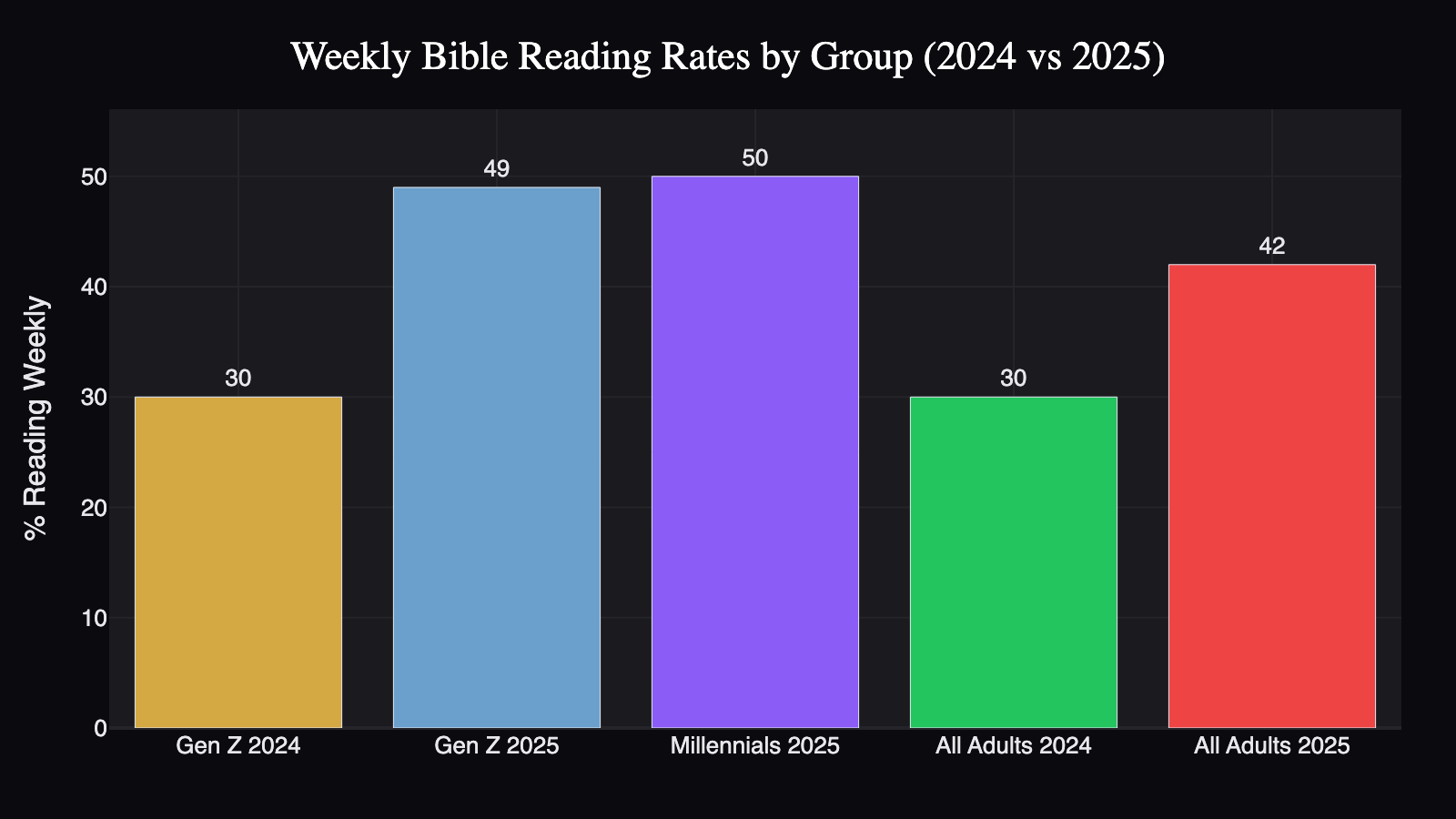
Bible reading in America is at a 14-year high. According to the Barna Group's State of the Church 2025, weekly Bible reading among U.S. adults jumped from 30% in 2024 to 42% in 2025, the largest single-year gain since tracking began. Among Gen Z, weekly readership rose 19 points to 49%. Among Millennials, it climbed to 50%.
That surge tells you something: people want to engage with Scripture, but wanting to start and knowing how to start are different problems.
This guide gives you a practical path. Whether you've never opened a Bible or you've read it for years without a clear method, these steps will help you read with more focus, context, and meaning. Tools like ScriptureVerse are changing how people approach this - visualizing all 31,102 verses and 340,000+ cross-references as an interactive cosmos, making the connections between passages visible in a way no static commentary can.
What Does It Actually Mean to Study the Bible?
Studying the Bible means reading with intent: asking what a passage says, what it meant to its original audience, and what it means for your life today.
That's different from reading for inspiration. Many people pick up a Bible, skim a chapter, and walk away with a vague impression. Genuine study involves slowing down, asking questions, examining context, and tracing how ideas connect across the whole text.
The three-step framework most scholars and teachers use is Observe, Interpret, Apply - often called OIA. Observe: what does the text actually say? Interpret: what did it mean to its original readers? Apply: what does that mean for me now? The Navigators, one of the oldest discipleship organizations in the country, have built their inductive Bible study guide around this framework for decades.
Where Should a Beginner Start Reading the Bible?
A beginner should start with the Gospel of John, then move to Genesis, then work through the New Testament before tackling the full Old Testament.
The Bible is not organized chronologically, and reading from Genesis straight through can overwhelm first-time readers before they reach the New Testament. John's Gospel gives you the center of the Christian story: who Jesus is, what he taught, and why it matters. John 3:16 is the famous anchor, but the whole book is a sustained meditation on identity, redemption, and eternal life.
After John, Genesis gives you the foundation: creation, the fall, the covenant with Abraham, and the lineage that runs straight into the New Testament. Once those two anchors are in place, Psalms offers emotional range, Romans gives theological depth, and Acts gives historical movement. For a fuller picture of how the two halves of the Bible connect, Bible Testaments Explained: Old & New Testament Guide covers the landscape clearly.
One practical note: don't read too much at once. A chapter a day with real time to sit with it will take you further than a chapter-per-minute marathon through Leviticus.
What Is the Inductive Bible Study Method?
The inductive method is the most widely taught approach to personal Bible study, using direct observation of the text before consulting commentaries or external sources.
The core idea: don't let someone else tell you what a passage means before you've read it yourself. Start with what's there, then bring in tools. Daniel Yoon's seven-step guide at Logos expands the basic OIA framework into a full process:
- Pray for understanding before you open the text
- Read the passage in full without stopping
- Observe what the text actually says - not what you assume
- Ask the journalist's questions: who, what, where, when, why, how
- Examine context: the chapter, the book, the historical background
- Interpret: what did this mean to the original audience?
- Apply: what does this ask of you today?
The method works across any genre - narrative, poetry, prophecy, epistle. The process just adapts depending on what you're reading.
Pro Tip: For any passage that mentions a specific person or event, follow the cross-references. A verse like Romans 8:28 connects to dozens of other passages that illuminate its meaning. ScriptureVerse makes those 340,000+ connections visible as a live map - so when you pull on one thread, you see exactly where it leads.
What Tools Do You Need to Study the Bible?
The right tools depend on your depth goal, but every serious student benefits from a trusted translation, a concordance, and access to basic commentary.
Here's a practical breakdown by study level:
Beginner:
- A readable modern translation (ESV, NIV, CSB, or NLT)
- A notebook or journaling Bible
- One free digital tool like BibleGateway or YouVersion
Intermediate:
- Multiple translations for comparison
- Strong's Concordance for word-level study
- Blue Letter Bible - free Greek and Hebrew lexicons with Matthew Henry commentary included
Advanced:
- Original language resources (Greek New Testament, Hebrew Bible)
- ATLA Religion Database for peer-reviewed journal access
- Full commentary sets or seminary-level resources
The digital landscape in 2026 makes intermediate-level study accessible to anyone. Blue Letter Bible's study resources page puts Strong's Concordance, multiple commentaries, and Bible reading plans in one free interface. BibleGateway offers translation comparison across 50+ English versions at no cost.
Bible Study Tools at a Glance
| Tool | Best For | Cost | Original Languages |
|---|---|---|---|
| BibleGateway | Translation comparison, topical search | Free | No |
| Blue Letter Bible | Word study, Greek/Hebrew lexicons | Free | Yes |
| Logos Bible Software | Deep research, full commentary sets | Paid ($$$) | Yes |
| YouVersion | Daily reading plans, mobile devotionals | Free | No |
| ScriptureVerse | Cross-reference visualization, AI teaching | Paid (trial) | Via AI teacher |
ScriptureVerse sits in a category of its own. Rather than presenting more text to read, it renders the entire cross-reference network as an explorable 3D galaxy. When you look at Jeremiah 29:11, you don't just read the verse - you see every passage it connects to and can follow any thread directly. The AI Teacher sees the same visualization you're looking at and guides your study in real time.
Why Does Context Matter So Much in Bible Study?
Context is the single factor that separates a misread Bible passage from a well-understood one, because nearly every misquoted or misapplied verse comes from reading it in isolation.
Philippians 4:13 - "I can do all things through Christ who strengthens me" - is one of the most quoted verses in the English-speaking world. Read in context, Paul is writing from prison about learning contentment in both abundance and scarcity. The verse is about endurance through hardship, not a general promise of success in any endeavor.
Context operates on multiple levels:
- Immediate context: the verses directly before and after
- Chapter context: the full argument of the chapter
- Book context: the author's purpose and intended audience
- Canonical context: how the passage fits within the whole Bible
- Historical context: the culture, geography, and events behind the text
Tracking canonical context - how themes echo from Genesis through Revelation - is where visualization tools have a real advantage. Bible verses about faith span both Testaments and carry different textures depending on genre: Hebrews 11 reads differently than Habakkuk 2:4, even when both point toward the same underlying conviction.
What Does 2 Timothy 3:16 Say About Why We Study the Bible?
Paul's foundational statement in 2 Timothy 3:16-17 gives four practical purposes for Scripture: teaching, rebuking, correcting, and training in righteousness.
The Greek word theopneustos - translated "God-breathed" - appears only once in the New Testament. It's a compound of theos (God) and pneo (to breathe), meaning Scripture carries the weight of divine speech, not merely human wisdom. Classical commentators read this as encompassing both Testaments: all of holy Scripture is the breath of God.
That framing has a practical implication for how you study. If the Bible is God-breathed, then reading it only for inspiring quotes misses what it's designed to do. Paul's four purposes - teaching, reproof, correction, training - suggest the text is meant to shape you over time, not just comfort you in the moment.
This is why consistent, methodical study matters more than occasional reading. Even 15 focused minutes three times a week will move you further than an hour of undirected browsing.
How Do You Build a Consistent Bible Study Habit?
A consistent Bible study habit forms around a fixed time, a manageable scope, and a simple method you can sustain when motivation runs low.
Research from the American Bible Society's State of the Bible 2025 shows that 41% of U.S. adults now qualify as "Bible Users" - engaging Scripture at least three times a year outside of worship, up from 38% in 2024. Regular study three or more times a week is where lasting formation happens, and that requires systems, not willpower.
Practical habits that stick:
- Set a fixed daily time, morning or evening, and keep it consistent
- Choose a physical location your brain associates with focused reading
- Use a reading plan so you're not deciding what to read each day
- Keep a journal nearby - write one observation and one question per session
- Find a study partner or small group for accountability
The SOAP method - Scripture, Observation, Application, Prayer - works well for journaling because it structures each session in four short steps, taking about 20 minutes once you've practiced it a few times.
For a broader look at how to go deeper with your study over time, Content Bible Studying: Methods, Tools & How to Go Deeper covers methods and resources in detail.
 weekly-bible-reading-rates-2024-2025
Frequently Asked Questions
Q: What is the best Bible translation for beginners?
The ESV (English Standard Version) and NIV (New International Version) are both strong starting points. ESV leans more literal and is widely used in academic and church settings; NIV is slightly more readable without sacrificing accuracy. Either will serve you well through your first year of study.
Q: How long should a Bible study session be?
Twenty to thirty minutes of focused study is more productive than an hour of distracted reading. Consistency matters more than length - three 20-minute sessions per week will produce more growth than one scattered two-hour session.
Q: Can I study the Bible without knowing Greek or Hebrew?
Yes. Most serious Bible study happens in translation, and modern free tools like Blue Letter Bible give you access to Greek and Hebrew definitions without requiring fluency. Knowing a few key terms - like agape (unconditional love), shalom (peace and wholeness), or theopneustos (God-breathed) - adds meaningful depth to any passage you study.
Q: What is the difference between Bible reading and Bible study?
Bible reading is moving through the text to build familiarity; Bible study is slowing down to ask what a passage says, what it means, and what it requires of you. Both matter - reading builds the map, study builds understanding of what's on it.
Q: How do I find cross-references between Bible passages?
Cross-references appear in the margins of most study Bibles, in a concordance, or through digital tools. ScriptureVerse visualizes the full 340,000+ cross-reference network as an interactive graph, so you can follow any verse's connections in real time rather than flipping between pages.
Q: Is there a right order to read the Bible?
There is no single right order. Beginners benefit from starting with John, then Genesis, then the rest of the New Testament before the full Old Testament. Chronological reading plans rearrange passages in historical sequence - useful for narrative flow, but challenging for newcomers.
Q: What questions should I ask when studying a Bible passage?
Start with these seven: What does this actually say? Who wrote it and to whom? What was happening historically? What did this mean to the original audience? What words or themes repeat? What does this connect to elsewhere in Scripture? What does this ask of me today? Those questions will carry you through any passage in any genre.
Ready to see Scripture's hidden connections? ScriptureVerse visualizes every verse and cross-reference as an interactive cosmos. Start exploring →