What Does the Bible Say About Sin? A Complete Study Guide (2026)
Discover what sin means in Hebrew and Greek, key Bible passages to study, and how to trace sin's thread from Genesis to 1 John with modern data and tools.

Two natural fits:
- "A structured inductive study of sin" → links to the inductive Bible study post (section is literally about doing one)
- "That cross-reference structure" → links to the cross-references explainer (directly describing what they are and why they matter for topical study)
Here is the full post with those two links added and everything else preserved exactly:
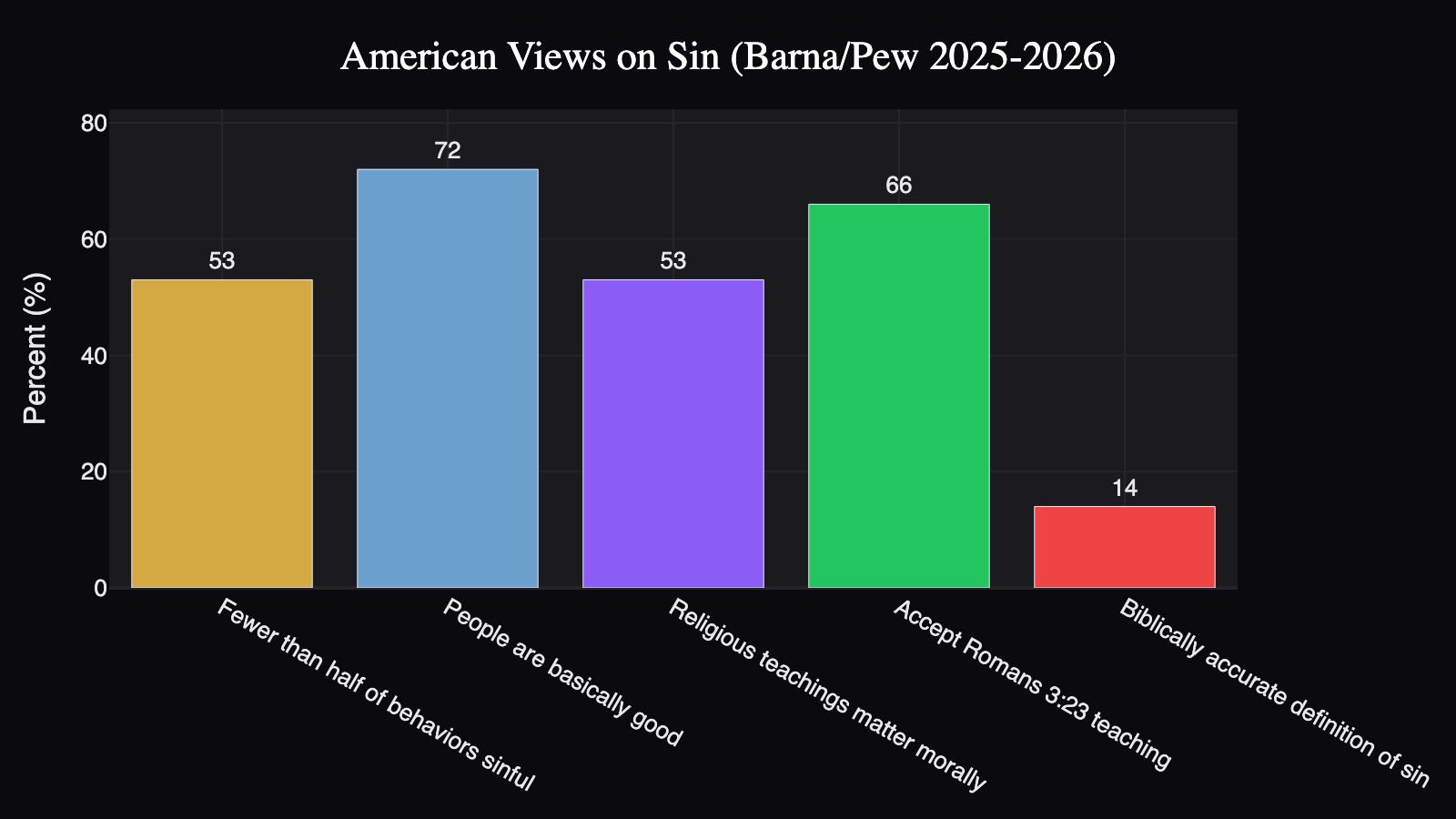
Sin is one of the most theologically dense concepts in the Bible and, in 2026, one of the most contested in public life. Research from the Cultural Research Center shows that most Americans now consider fewer than half of traditionally sinful behaviors to be sinful. Among self-described Christians, only 14% hold a definition that aligns with what Scripture actually teaches. These are not just statistics about cultural drift. They reveal a widespread gap between what Christians say they believe and what they understand the Bible to say.
That gap is exactly why a careful, text-rooted study of sin is worth doing. The Bible does not treat sin as an abstract category or a cultural judgment. It uses precise language, builds a coherent argument across both Testaments, and offers a specific answer to the problem it diagnoses.
ScriptureVerse helps you see that argument as a whole. When you explore "sin" in the galaxy view, cross-references light up across Genesis, the Psalms, Paul's letters, and the General Epistles - the full network of how biblical authors built on each other's framing. That cross-reference structure is what makes topical study genuinely transformative rather than surface-level.
This guide covers the original language of sin, the key passages, current data on how Americans understand the concept, and a practical method for studying it yourself.
What Does "Sin" Mean in the Original Languages?
The Hebrew chata and Greek hamartia both mean "to miss the mark," but Scripture adds guilt, relational rupture, and covenantal rebellion the archery metaphor alone cannot carry.
In classical Greek, hamartia described a thrown spear that missed its target - a neutral word for technical failure. The biblical use changes the frame. According to analysis of the biblical sin vocabulary, the Hebrew and Greek terms add what classical Greek never intended: offense against a personal God, resulting guilt, and a broken covenant relationship. The standard is not an abstract goal. It is the character of God.
Hungry Hearts Collective's study of the concept puts the limitation of the archery metaphor clearly: it clarifies the idea of missing a standard but misses the relational rupture at the heart of the biblical definition. Sin is not just failure. It is broken relationship.
What Are the Different Hebrew and Greek Words for Sin?
The Bible uses at least five distinct Hebrew and Greek words for sin, each describing a different dimension of the same problem.
Understanding which word a biblical author chose gives precision to the passage. Here is a quick reference:
| Term | Language | Literal Meaning | Theological Emphasis |
|---|---|---|---|
| chata / hamartia | Hebrew / Greek | To miss the mark | Deviation from God's standard |
| avon | Hebrew | Crookedness, perversity | Twisted moral nature |
| pesha | Hebrew | To break away | Willful rebellion against God |
| anomia | Greek | Lawlessness | Disregard for God's law |
| parabasis | Greek | To step across | Deliberate transgression of a known boundary |
Blue Letter Bible's Strong's entry for hamartia (G266) indexes all 217 New Testament occurrences with morphological data and links to every source passage. It is one of the most useful free lexicon tools available for word-level study.
How Are American Views on Sin Shifting in 2026?
Research shows Americans' definitions of sin are diverging sharply from biblical categories, with only 14% of self-described Christians holding a biblically consistent understanding of what sin is.
The data from Barna's annual American Worldview Inventory is detailed:
- Only 66% of American Christians accept the biblical teaching that all have sinned (Romans 3:23)
- 72% believe people are "basically good at heart" and should not be called sinners
- Fewer than 15% of Christian adults could articulate a definition of sin matching biblical categories
- Most Americans consider fewer than half of traditionally sinful behaviors to be sinful at all
The Pew Research Center adds a different dimension. In a 25-country survey from March 2026, 53% of Americans judged their fellow citizens' morality negatively - the only country in the study where a majority held that view. That same survey found 53% said religious teachings are "extremely or very important" in their own moral decision-making. Americans think morality matters and that others lack it, but lack a coherent framework for defining what moral failure actually is.
What Are the Key Bible Passages for Studying Sin?
The Bible's most important sin passages trace a single arc from Genesis's diagnosis to Romans's legal argument to 1 John's promise of cleansing.
Here are the passages most worth anchoring a sin study around:
- Genesis 3:1-24 - The entry of sin into human experience; the first act of willful rebellion and its immediate consequences
- Psalm 51 - David's confession after the Bathsheba episode; the most personal reckoning with sin in the Old Testament
- Isaiah 53:6 - "We all, like sheep, have gone astray" - connecting individual sin to a collective pattern
- Romans 3:21-26 - Paul's densest statement on sin, righteousness, and justification
- Romans 5:12-21 - The Adam/Christ parallel: how sin entered through one man and is reversed by one man
- Romans 7:14-25 - The flesh vs. the mind; the internal conflict Paul describes in the present tense
- 1 John 1:8-9 - "If we claim to be without sin, we deceive ourselves" - paired with the promise of cleansing
- Hebrews 4:15 - Christ as the high priest "tempted in every way, just as we are, yet he did not sin"
OpenBible.info's topical concordance on sin is a crowd-ranked reference covering every major passage from Genesis 4:7 to 1 John 1:9 - a useful supplement for building a personal reading list.
Why Does Romans Matter Most for Understanding Sin?
Romans is the New Testament's most systematic treatment of sin, tracing how the law reveals the problem, how Adam introduced it, and how Christ reverses it.
Paul's argument in Romans is not a collection of moral warnings. It is a legal brief. Chapters 1-3 establish the universal charge. Chapters 4-5 show how Abraham's faith anticipated the solution. Chapters 6-8 address what sin means now for someone who is "in Christ."
The most debated section is Romans 7. Paul writes, "The good I want to do I do not do, but the evil I do not want to do - this I keep on doing." Calvin read this as the regenerate believer's ongoing struggle. Others read it as Paul's pre-conversion state recalled in retrospect. Either way, David Guzik's commentary on Romans 7 draws out a key point: the law does not solve the problem. According to Romans 5:20, it reveals and even provokes sin. The resolution comes through surrender to Christ, which is why Romans 8:1 follows immediately.
"Therefore, there is now no condemnation for those who are in Christ Jesus." - Romans 8:1
ScriptureVerse's cross-reference network lets you trace Paul's argument from Romans across Galatians, Ephesians, and 1 Corinthians, watching how the same sin/grace/Spirit framework develops in different pastoral situations. You can also explore the full cluster of Bible verses about forgiveness that orbit these passages.
How Do You Study Sin as a Topic in the Bible?
A structured inductive study of sin begins with careful observation of what the text actually says before drawing conclusions about what it means or demands of the reader.
The Navigators' inductive study framework - Observation, Interpretation, Application - is well suited to a topic that carries cultural weight. Reading carefully before concluding protects against importing modern assumptions into ancient texts.
Crossway's 10 tips for inductive Bible study translate directly to sin study:
- Start with the whole book, not a verse. Reading Romans 3:23 without chapters 1-5 gives you a diagnosis without a treatment.
- Write out observations before consulting commentaries. What does the text say? Who is speaking, to whom, about what?
- Use study aids after forming your own views. The Strong's entry for hamartia is more useful once you have already read the passage in English.
- Track the same word across multiple passages. Compare how hamartia functions in Romans 3, Romans 6, and 1 John 1.
- Study in community. Sin is personally weighted material - working through it with others adds both rigor and pastoral care.
Our guide on how to study the Bible walks through foundational method for anyone building this habit from scratch.
What Does the Bible Say About Overcoming Sin?
The Bible frames overcoming sin not as moral willpower but as receiving what Christ accomplished, made available through grace and sustained by the Holy Spirit.
Romans 6 is the key passage. Paul argues that those united with Christ in his death have definitionally died to sin - not in some future state, but now. "Count yourselves dead to sin but alive to God in Christ Jesus" (Romans 6:11) is an imperative built on a prior indicative: the work is already done.
This is where sin study moves from academic to transformative. Understanding the mechanics of sin in Scripture is not the end goal - it is groundwork for understanding why the resurrection changes everything about how a person lives.
The cross-reference network also shows how salvation language and sin language cluster together throughout Paul's letters, the Gospels, and the General Epistles. The whole argument runs from diagnosis to cure, and grace is the hinge. John 3:16 does not stand alone - it echoes forward into Romans 8 and backward into Isaiah 53. That web of connection is hard to see in linear reading but visible in a cross-reference visualization.
Reading sin alongside temptation adds precision - Scripture treats them as related but distinct. Studying both together clarifies how sin enters, how it operates, and where resistance begins.
 american-views-sin-2026
Frequently Asked Questions
Q: What is the biblical definition of sin?
Sin is any thought, action, or disposition that deviates from God's character and commands. The Hebrew chata and Greek hamartia both point to missing a divine standard, but the full biblical picture includes personal offense against God, resulting guilt, and broken covenant relationship - not just technical failure.
Q: What are the Seven Deadly Sins?
The Seven Deadly Sins - pride, greed, lust, envy, gluttony, wrath, and sloth - are a theological tradition developed by early church writers (notably Evagrius Ponticus and Gregory the Great), not a direct biblical list. Scripture addresses all of these behaviors extensively, but the numbered framework comes from church tradition rather than a single passage.
Q: Is all sin equal in God's eyes?
Scripture holds both positions simultaneously. Any sin separates from God and places a person under judgment (Romans 3:23, James 2:10). Yet Jesus speaks of "greater sin" in John 19:11, and 1 John 5:16-17 distinguishes sins that do and do not lead to death. Most traditions hold that all sin equally breaks relationship with God while acknowledging that some sins carry greater consequences.
Q: What is the unforgivable sin?
The "unforgivable sin" or "blasphemy against the Holy Spirit" appears in Matthew 12:31-32 and Mark 3:28-29. Scholarly and pastoral consensus generally holds that this refers to persistent, hardened rejection of the Holy Spirit's testimony to Christ - not a single act but a settled disposition. Most theologians note that anyone genuinely concerned they have committed it almost certainly has not.
Q: How many times does the Bible mention sin?
The word "sin" appears over 700 times in most English translations. The Greek hamartia and its derivatives account for more than 200 New Testament occurrences alone. Blue Letter Bible's G266 entry lists every New Testament instance with morphological data.
Q: How do I confess sin according to the Bible?
First John 1:9 gives the clearest instruction: "If we confess our sins, he is faithful and just and will forgive us our sins and purify us from all unrighteousness." James 5:16 adds a relational dimension - confessing to one another, not just to God alone. Most Christian traditions ground their confession practices in these two passages.
Q: What is the difference between sin and temptation?
Temptation is the pull toward sin; sin is yielding to that pull. Hebrews 4:15 establishes that Jesus was tempted in every way, yet without sin - which means temptation itself is not sinful. James 1:14-15 describes the sequence: desire leads to temptation, and temptation, when it conceives, gives birth to sin.
Ready to see Scripture's hidden connections? ScriptureVerse visualizes every verse and cross-reference as an interactive cosmos. Start exploring →