Bible Questions Answered: What People Are Asking Most in 2026
The most common Bible questions people search in 2026, from authorship to contradictions to translation choice, with honest answers and the tools that help.

Looking through the post for plain text that naturally matches existing post topics, I found three clean fits:
- "Blue Letter Bible" in the translation section (plain text) → Blue Letter Bible review
- "typology" in the contradictions step-list → Typology in the Bible post
- "cross-reference visualization" in the tools framework → Bible apps with cross-reference visualization comparison
Here is the post with those three links added and nothing else changed:
The Bible is the most-read book in human history, yet the questions it generates show no sign of running out. Theologian Ian Paul analyzed listener questions from a Premier Radio Bible phone-in and found that no question repeated across four separate call-in sessions - which suggests the supply of genuine Bible questions is effectively inexhaustible. That pattern lines up with what Google search data shows: spikes in Bible-related searches track closely with periods of cultural disruption, as if people instinctively reach for Scripture when the world stops making sense.
The questions range from the foundational - who wrote this, and can I trust it? - to the granular: what exactly did Jesus mean in Luke 17:37 by "where a dead body is, there the vultures will gather"? Each deserves a real answer.
ScriptureVerse was built for exactly this moment. The platform renders all 31,102 verses and 340,000+ cross-references as an interactive 3D cosmos, so when you ask a question about a passage, you can see every related verse the original authors were working with. The AI Teacher knows which verse you are looking at and responds within that visual context - not a generic search result, but a situated response to your specific question.
This post covers the Bible questions people search for most, how modern tools are changing how they get answered, and where to look when you need more than a snippet.
Why Are People Asking More Bible Questions Than Ever?
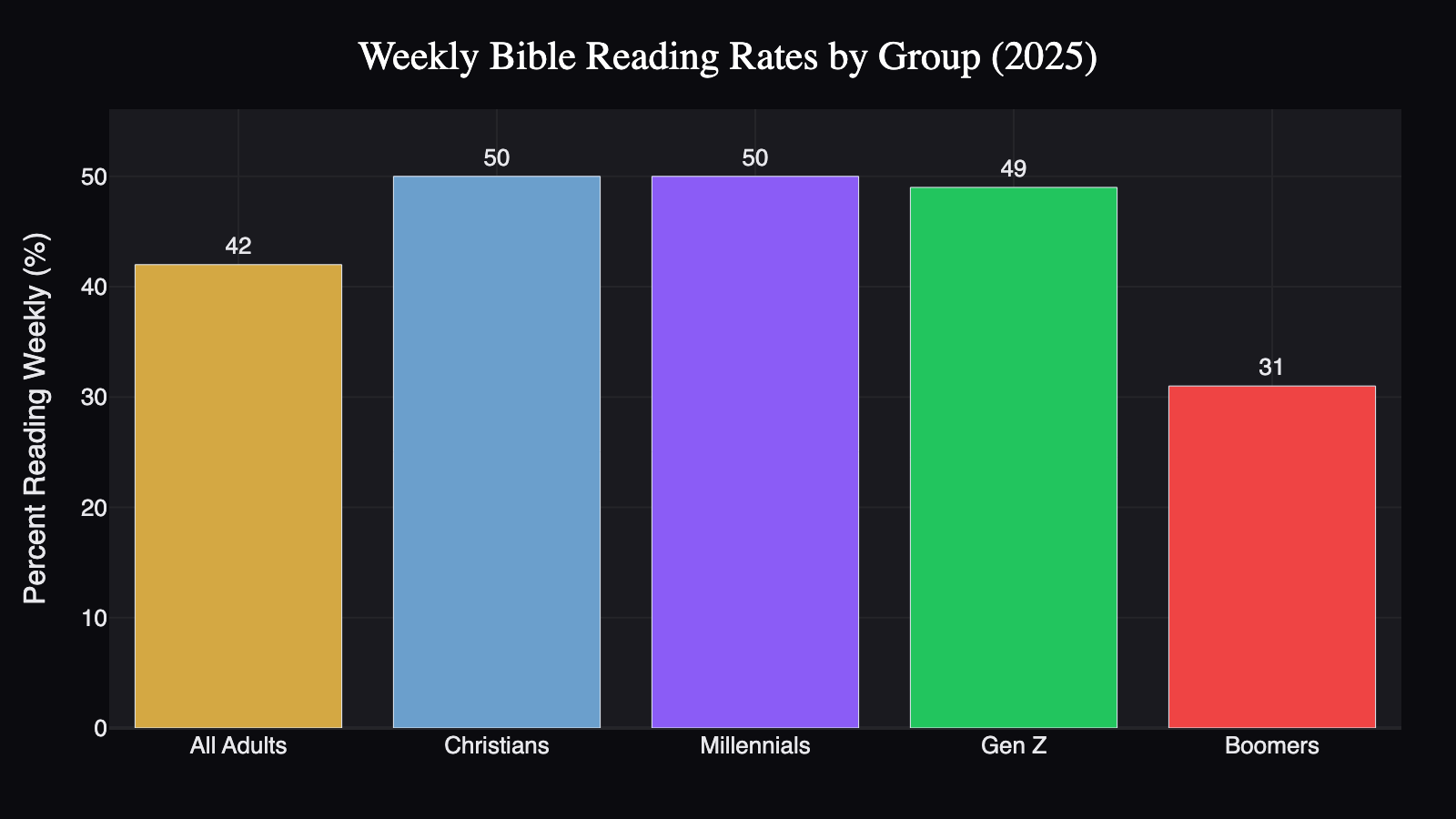
Bible reading rose sharply in 2025, with Millennials jumping 16 points to 50% weekly readership and Gen Z climbing from 30% to 49% in a single year.
Barna Group's State of the Church 2025 report found that weekly Bible reading among U.S. adults climbed to 42%, up from a 25-year low of 30% in 2024. Among self-identified Christians the figure reaches 50%, the highest level in over a decade. Gen Z men now read at 54% and Millennial men at 57%, outpacing women in both cohorts for the first time in the data.
The same report surfaces a tension worth understanding: more Americans are reading the Bible than at any point since 2012, yet fewer strongly affirm its authority. Curiosity is outrunning conviction. People arrive at the text without the generational scaffolding earlier readers carried - catechism classes, Sunday school routines, pastors who knew their congregation's questions by name. They come with genuine puzzlement.
That gap between readership and conviction creates demand for honest engagement with hard questions. A verse like Romans 8:28 ("all things work together for good") raises immediate questions about suffering and divine will. The surface reading is rarely the whole story.
What Are the Most Common Questions People Ask About the Bible?
Google search data shows the most-searched Bible questions cluster around authorship, textual contradictions, historical reliability, difficult passages, and which translation to use.
Research compiled by ForAllThings.Bible, drawing on LookInside.Bible and Google Trends analysis, identified five recurring question categories. Search volume for all of them spikes during major news events and periods of cultural disruption. These are not academic exercises for most people - they are urgent.
| Category | Example Questions |
|---|---|
| Authorship | Who wrote the Bible? Who wrote Genesis? |
| Contradictions | Does the Bible contradict itself? |
| History | Is the Bible historically reliable? |
| Interpretation | What does this passage actually mean? |
| Translation | Which Bible version is best for study? |
Answers in Genesis organizes its Bible questions hub into 15+ topical buckets: authorship, archaeology, Bible characters, contradictions, hermeneutics, prophecy, Noah's Flood, and more. Blue Letter Bible's FAQ covers six theological categories: Scripture, God, Christ, Christian Living, Eschatology, and Miscellaneous. Both organizations have found that reader demand is broad, persistent, and rarely shallow.
Who Actually Wrote the Bible?
The Bible has more than 40 human authors writing across roughly 1,500 years, yet theologians across traditions identify a single divine intelligence unifying the whole text.
Hope.Study's guide to the 50 most-asked Bible questions frames the authorship question this way: behind every named human author - Moses, David, Isaiah, Paul, John - sits the same divine Author guiding all of them. The theological term is plenary verbal inspiration: every word is both genuinely human and genuinely given.
The historical spread is remarkable. The texts attributed to Moses date to the second millennium BC. The apostle John likely wrote Revelation in the mid-90s AD. That is more than a millennium between the earliest and latest texts, covering genres from poetry to law to prophecy to letters to apocalyptic vision.
What holds the library together is exactly the question that makes cross-reference study so compelling. When you trace Jeremiah 29:11 ("plans to give you hope and a future") through its Babylonian exile context and see how that restoration theme echoes across the New Testament, a coherent authorial intent becomes visible across the whole canon.
Does the Bible Contradict Itself?
Apparent contradictions in Scripture are real reading experiences; theologian Ian Paul found that careful Christian readers notice textual tensions and consistently need better tools to resolve them.
Ian Paul, Associate Senior Research Fellow at the Kirby Laing Centre for Public Theology and Managing Editor of Grove Books, analyzed listener questions from Premier Radio's Bible phone-in and concluded that faithful readers are far from uncritical. They notice when Gospel accounts differ on detail. They catch when Paul seems to say two different things about the law. They want real engagement, not reassurance.
The productive approach involves a few steps:
- Identify the genre. Poetry (Psalms), law (Deuteronomy), prophecy (Isaiah), and epistle (Romans) each have different rules for what "accuracy" means.
- Check the original context. Many apparent contradictions dissolve when the historical and cultural setting is recovered.
- Follow the cross-reference chain. A "contradicting" passage in a later book often intentionally reworks an earlier one - typology, fulfillment, or canonical development.
- Consult the scholarly tradition. Harvard Divinity School's library research guide notes that serious study requires following citation chains back to primary sources rather than relying on commentary summaries.
- Sit with what remains. Not every tension resolves neatly. Some require theological humility and extended study rather than a quick answer.
The Evangelical Biblical Theology Commentary series (EBTC), which released new volumes on Deuteronomy and 1 Corinthians in 2025, situates each book within the Bible's overall storyline rather than treating texts as isolated units. That frame helps apparent contradictions make sense as part of a developing canonical argument.
Which Bible Translation Should You Use?
No single translation works best for every purpose: word-for-word versions like ESV prioritize accuracy, while thought-for-thought versions like NIV or NLT prioritize readability for modern readers.
Here is a practical guide:
- Word-for-word (formal equivalence): ESV, NASB, KJV, NKJV - best for close study of specific wording, original-language comparison, and memorization
- Thought-for-thought (dynamic equivalence): NIV, NLT, CSB - best for reading comprehension, devotional use, and readers new to the Bible
- Paraphrase: The Message, The Living Bible - useful for fresh perspective on familiar passages; not reliable for doctrinal precision
- Study Bibles: Combine a reliable translation with scholarly notes, maps, and cross-references built in
For serious word study, original-language tools matter more than translation choice. Blue Letter Bible, launched in 1996, was named as a play on red-letter Bibles - the idea that every word should link outward to a study resource. That linking principle is still one of the most useful functions in lexical Bible study.
For questions about how passages connect to each other across the canon, translation choice matters less than having a way to see the cross-reference network. Seeing all the connections from Matthew 11:28 ("come to me, all who are weary") laid out visually is a different kind of understanding than reading a footnote about parallel texts.
How Is AI Changing the Way People Answer Bible Questions?
AI is reshaping Bible study in 2026: Barna found that roughly four in ten practicing Christians say AI has already helped them with prayer, study, or spiritual growth.
Barna's Insights on Tech, Media and Faith in 2026 report adds a sharper finding: nearly one in three U.S. adults say spiritual advice from AI is as trustworthy as advice from a pastor. Among Gen Z and Millennials, that figure rises to two in five.
That represents a significant shift in where people take their questions. It does not mean AI is replacing pastors or commentaries. What it means is that the barrier to engaging a hard Bible question has dropped. Someone can ask a follow-up at 11 PM, in plain language, without knowing which scholar to look up or waiting until Sunday.
The difference in a tool like ScriptureVerse is that the AI Teacher does not answer in isolation. It answers while seeing the same visualization context you are looking at. If you are exploring the cross-references from Psalm 23:1 ("the Lord is my shepherd"), the Teacher can trace that shepherd motif through Ezekiel 34 and John 10 within the same session - contextual continuity that a standalone chatbot cannot offer.
For a broader comparison of how these tools work in practice, see the AI Bible study tools guide and the Bible apps with AI features comparison.
Where Should You Look When the Bible Raises Hard Questions?
The best place to start with a hard Bible question is the passage itself: original context, cross-references, and literary genre shape meaning before any commentary enters.
Here is a practical framework:
Start with the text:
- Read the whole chapter, not just the verse
- Identify the genre (law, poetry, prophecy, epistle, narrative)
- Note who is speaking, to whom, and under what circumstances
Expand to cross-references:
- What other passages use the same language or imagery?
- Is there an Old Testament root to a New Testament statement?
- Does the theme develop across the canon?
Match your tools to your question:
- Lexical questions (what does this word mean in Hebrew or Greek?) - original-language lexicons
- Historical questions (what was the situation?) - Bible dictionaries and archaeological commentary
- Theological questions (what does this teach about God?) - systematic and biblical theology resources
- Connection questions (how does this relate to other passages?) - cross-reference visualization
For questions touching on faith that run through both Testaments, topical study opens up the full conversation the text is having with itself across centuries.
Pro Tip: Ian Paul's Premier Radio research found that no Bible question repeated across four separate call-in sessions. If your question feels too obscure or too specific, it is not. The supply of genuine questions about Scripture is inexhaustible. The goal is not to run out of questions but to develop the tools and patience to engage them well.
 bible-reading-rates-2025
Frequently Asked Questions
Q: What is the most commonly asked question about the Bible?
The most consistently searched Bible question is some form of "who wrote the Bible?" Authorship questions lead search volume across multiple studies, followed by questions about contradictions and historical reliability. These searches spike during periods of cultural uncertainty and major news events.
Q: Does the Bible contradict itself?
Careful readers regularly notice what appear to be contradictions, and those observations deserve serious engagement. Many apparent contradictions resolve when the historical context, literary genre, or cross-reference network is taken into account. Some tensions reflect genuine theological development across the canon and require sustained study rather than a quick resolution.
Q: How many authors wrote the Bible?
The Bible has more than 40 identifiable human authors writing across roughly 1,500 years in Hebrew, Aramaic, and Greek. They include shepherds, kings, fishermen, priests, and scholars. Christian theology holds that a single divine Author guided all of them, giving the library coherence across its full span.
Q: Which Bible translation is best for study?
For close study of specific wording, ESV or NASB offer the most literal rendering of the original languages. For reading comprehension and accessibility, the NIV or NLT work well. The best choice depends on what you are studying and why, and serious students often use two or three translations in parallel.
Q: What are the hardest questions people ask about the Bible?
Based on Ian Paul's analysis of Premier Radio listener questions, hard questions include the meaning of obscure passages (Luke 17:37, 1 Kings 18), whether anyone can truly see God, how to interpret Joel 2, and how demonic influence operates. These are not fringe questions - they are what careful readers encounter when they read slowly and honestly.
Q: How do AI tools help with Bible questions?
AI Bible tools can provide immediate, contextual responses to hard questions, surface relevant cross-references, and explain historical background in plain language. Barna's 2026 research found that four in ten practicing Christians say AI has already helped them with Bible study. Tools that connect AI to the text itself - rather than operating as standalone chatbots - offer the most substantive engagement.
Q: Where can I find serious answers to Bible questions online?
Blue Letter Bible (launched 1996) organizes questions into six theological categories and links every word to original-language resources. Answers in Genesis covers 15+ topical categories including authorship, archaeology, and textual reliability. For questions that require seeing how passages connect, cross-reference visualization tools like ScriptureVerse let you trace relationships across the full Bible rather than reading about connections one footnote at a time.
Ready to see Scripture's hidden connections? ScriptureVerse visualizes every verse and cross-reference as an interactive cosmos. Start exploring →