Bible Testaments Explained: Old & New Testament Guide (2026)
Learn how the Old and New Testaments differ, connect through 340,000+ cross-references, and what reading strategies and tools work best for studying both in 2026.

The Bible is one book, but it arrives in two distinct movements. The Old Testament and New Testament are not two separate books bound together by accident; they are two acts of a single unfolding story, with the second act completing what the first announced.
For anyone trying to read Scripture systematically, or understand how a verse in Genesis connects to one in Revelation, knowing the structure of both testaments is the starting point. Platforms like ScriptureVerse visualize these connections as a living network of 31,102 verses and more than 340,000 cross-references, so the relationship between the testaments is not just described but visible.
According to the American Bible Society's State of the Bible 2026 report, 28% of Americans now fall into the "Movable Middle" - people curious about Scripture but not deeply engaged. Half of Americans say they have read at least half the Bible. Understanding how the testaments fit together is often the missing key that turns browsing into sustained study.
What Are the Two Testaments of the Bible?
The Bible contains two testaments: the Old covering creation through the Hebrew prophets, and the New covering Jesus' life, death, resurrection, and the early church.
The word "testament" comes from the Latin testamentum, translating the Hebrew brit and Greek diatheke, both meaning covenant. The Old Testament records God's covenant with Israel. The New Testament records the new covenant inaugurated by Jesus. Together they form a single theological arc stretching from Genesis 1 to Revelation 22.
The Old Testament accounts for roughly 77% of the Bible's total text. The New Testament, though smaller, contains the entire narrative of Jesus' ministry and every foundational document of Christian theology.
How Many Books Are in the Old and New Testaments?
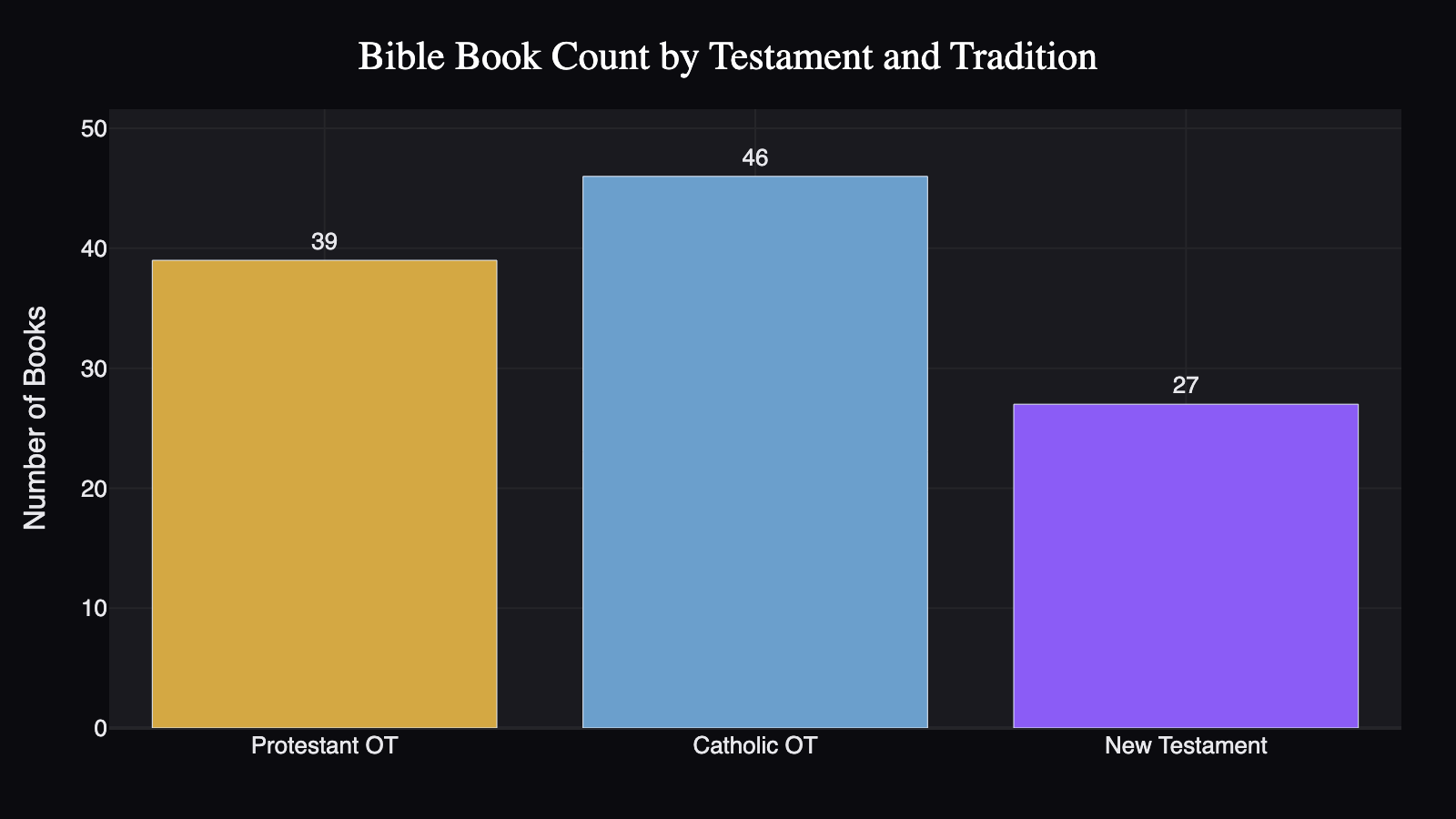
The Protestant Bible contains 66 books total - 39 in the Old Testament and 27 in the New - spanning 1,189 chapters across both collections.
Catholic tradition recognizes 73 books (46 Old Testament plus 27 New Testament), with the Deuterocanonical texts - Tobit, Judith, 1 and 2 Maccabees, Wisdom, Sirach, and Baruch - as the difference from the Protestant canon. Orthodox traditions include additional writings. The 27 New Testament books are held in common across all major Christian traditions. For a deeper look at how those decisions were made, see our post on what makes Scripture canonical.
Here is how the books break down by category:
| Section | Protestant OT | Catholic OT | NT (all traditions) |
|---|---|---|---|
| Law / Torah | 5 | 5 | - |
| History | 12 | 16 | 1 (Acts) |
| Wisdom / Poetry | 5 | 7 | - |
| Prophecy | 17 | 18 | - |
| Gospels | - | - | 4 |
| Letters / Epistles | - | - | 21 |
| Apocalyptic | - | - | 1 (Revelation) |
| Total | 39 | 46 | 27 |
How Is the New Testament Structured?
The New Testament's 27 books follow subject matter groupings rather than strict chronology, moving from the life of Jesus through early church history into theological letters and prophecy.
According to OverviewBible, those 27 books fall into five categories: the four Gospels (Matthew, Mark, Luke, John), Acts (early church history), Paul's letters to churches (Romans through 2 Thessalonians), Paul's letters to church leaders (1 Timothy through Philemon), and general letters (Hebrews through Revelation). This structure helps readers understand why a given book was written before they read it.
John 3:16 sits in the Gospel of John, but its full theological weight only becomes visible when you trace it back into Old Testament themes of faith and salvation. That back-and-forth reading is exactly what the testaments reward.
How Do the Old and New Testaments Connect?
The Old and New Testaments connect through more than 340,000 cross-references, with New Testament writers directly citing, echoing, and fulfilling themes established centuries earlier in Hebrew Scripture.
The New Testament quotes the Old Testament more than 300 times by direct citation, and alludes to it thousands more times. Matthew opens his Gospel by establishing Jesus as the fulfillment of Israel's story. Paul builds his entire argument in Romans on texts from Genesis, Psalms, and Isaiah. Revelation contains almost no original imagery - virtually every line echoes something written centuries before.
These connections are why seeing Romans 8:28 in isolation is different from seeing it networked to its Old Testament roots in a visual graph. The cross-reference web between testaments is one of Scripture's most striking structural features.
What Major Themes Run Through Both Testaments?
The major biblical themes spanning both testaments include covenant, grace, sacrifice, prayer, and the nature of God as simultaneously just and merciful.
Some of the clearest through-lines:
- Covenant: The Abrahamic covenant in Genesis 15 is reaffirmed in the Mosaic law, renewed in the Davidic promises, and fulfilled in the new covenant described in Hebrews 8-9.
- Sacrifice: The Levitical sacrificial system points forward to Christ's sacrifice in Hebrews 10. The parallels are structural, not coincidental.
- God's presence: From the tabernacle in Exodus to the Holy Spirit in Acts, where God dwells is a question both testaments answer progressively.
- Prophecy and fulfillment: Isaiah 53 was written approximately 700 years before Jesus. Its description of a suffering servant maps precisely onto the Gospel accounts of the crucifixion.
- Hope: From Jeremiah 29:11 to the promises of Revelation 21, the arc of Scripture bends consistently toward restoration.
"For I know the plans I have for you, declares the Lord, plans to prosper you and not to harm you, plans to give you hope and a future." - Jeremiah 29:11
The Barna Group research notes that 71% of Americans hold a view that regards Scripture as the word of God, and 54% say the Bible contains everything needed to live a meaningful life. These themes are why.
What Is the Best Strategy for Reading Both Testaments?
The most effective strategy for reading both testaments alternates between Old and New Testament passages daily to build interpretive context without stalling in the more demanding sections.
Several structured approaches:
- Parallel daily reading: One Old Testament chapter and one New Testament chapter per day. This keeps readers inside both story arcs simultaneously.
- Thematic pairing: Read a passage and its fulfillment side by side - Psalm 22 alongside Mark 15, or Isaiah 53 alongside Acts 8:26-35.
- Chronological order: Read the Bible in the historical sequence of events rather than canonical order. Particularly useful for placing Psalms and Proverbs within the timeline of Israel's history.
- Genre rotation: Some plans assign a different genre to each weekday - Law on Monday, History on Tuesday, Wisdom on Wednesday, Prophecy on Thursday, New Testament on Friday.
The Navigators Bible Reading Plan is one of the more practical options: 25 readings per month across both testaments, catch-up days built in, and designed to start any day of the year. Ligonier Ministries lists 20+ structured plans and includes R.C. Sproul's Bible overview for first-time readers. Their Tabletalk plan pairs one Old Testament and one New Testament passage each day, completing the full Bible in a year.
Does It Matter Which Testament You Read First?
Which testament to start with matters less than matching the reading approach to your current familiarity with Scripture and then following through consistently.
Complete beginners often benefit from starting in the New Testament - particularly the Gospel of John or Mark - to establish the central narrative before moving into the Old Testament's longer legal and historical sections. Matthew 11:28 - "Come to me, all you who are weary and burdened, and I will give you rest" - gives an immediate point of contact with Scripture's central claim without requiring prior context.
Readers with any prior familiarity typically build a richer picture faster by reading Genesis alongside a New Testament letter, letting each text illuminate the other in both directions.
According to Gitnux's 2026 compiled statistics, the Bible has been translated into more than 700 languages, yet 12,000+ language requests remain unmet. The structure of both testaments matters as much for a first-time reader approaching Scripture in any language as it does for a lifetime churchgoer.
What Tools Help You Study Both Testaments Together?
The most useful tools for studying both testaments together combine original-language access, cross-reference networks, and structured reading plans in a single interface.
Blue Letter Bible supports 12 English translations with integrated original-language tools for both testaments: Hebrew and Septuagint resources for the Old Testament, Greek tools for the New. The interlinear Bible, cross-references, and commentaries are all free.
YouVersion hosts a dedicated Old and New Testament reading plan alongside dozens of parallel OT/NT formats. The app is completely free with no advertising.
ScriptureVerse takes a different approach: instead of displaying one passage at a time, it renders the entire Bible as an interactive cosmos of 31,102 verse-nodes connected by 340,000+ cross-reference edges. When you're reading John 3:16, you can see every thread connecting it back into the Old Testament in real time. The AI Teacher knows which visualization lens you're using and can guide you through both testaments as a unified whole rather than two unrelated collections.
For more on evaluating study tools, see Bible Understanding: Methods, Context & Tools for Deeper Study.
 testament-book-count
Frequently Asked Questions
Q: What is the difference between the Old Testament and the New Testament?
The Old Testament records God's covenant with Israel from creation through the Hebrew prophets, covering approximately 1,500 years of history. The New Testament records the life, death, and resurrection of Jesus and the growth of the early church, presenting Jesus as the fulfillment of the Old Testament's prophecies and promises.
Q: How many books are in each testament?
Protestant Bibles contain 39 Old Testament books and 27 New Testament books, for a total of 66 books and 1,189 chapters. Catholic Bibles contain 46 Old Testament books and 27 New Testament books (73 total), including the Deuterocanonical texts. The 27 New Testament books are shared across all major Christian traditions.
Q: Why does the New Testament quote the Old Testament so often?
The New Testament writers were Jewish believers who read Jesus' life within the framework of Hebrew Scripture. They quoted and alluded to the Old Testament to show how Jesus fulfilled what prophets, psalms, and law pointed toward. Some scholars estimate more than 300 direct quotations and thousands of additional allusions.
Q: What is the best book to start reading in the Old Testament?
Genesis establishes the foundational stories of creation, the fall, Abraham, Isaac, Jacob, and Joseph - making it the natural starting point. Psalms works well as a parallel devotional entry point, and Proverbs for practical wisdom. Proverbs 3:5 is one of the most useful summaries of Old Testament wisdom: "Trust in the Lord with all your heart, and lean not on your own understanding."
Q: Is one testament more important than the other?
Most Christian traditions hold both testaments as equally authoritative Scripture. The New Testament depends on the Old for its entire framework - without the covenants, prophecies, and promises of the Old Testament, the New Testament's claims about Jesus are much harder to understand. The two testaments interpret each other.
Q: What is typology and why does it matter for reading the testaments together?
Typology is the interpretive method of reading Old Testament people, events, and institutions as "types" that point forward to New Testament realities. Adam is described as a type of Christ in Romans 5. The Passover lamb is a type of Christ's sacrifice in 1 Corinthians 5. The temple is a type of Jesus' body in John 2. This method of reading unifies both testaments as a single theological narrative rather than two separate books.
Q: What reading plan covers both testaments in one year?
Several reliable one-year plans cover both testaments. The Navigators/Discipleship Journal plan provides 25 readings per month with built-in catch-up days. Ligonier's Tabletalk plan pairs one Old Testament and one New Testament passage per day. YouVersion hosts both chronological and canonical formats at no cost. Consistency matters more than which plan you select.
Ready to see Scripture's hidden connections? ScriptureVerse visualizes every verse and cross-reference as an interactive cosmos. Start exploring →