Bible Translations Guide: Types, Accuracy & How to Choose (2026)
Understand every major Bible translation in 2026: formal vs. dynamic equivalence, accuracy rankings from scholars, and a step-by-step guide to choosing the right version.

Every English Bible on your shelf is a translation decision. Committees of scholars chose specific manuscripts, applied specific philosophies, and made thousands of judgment calls that shape every sentence you read. Whether you're sitting with John 3:16 in the NIV or the NASB, the words feel similar, but the reasoning behind each version can differ significantly.
That difference matters more than most readers realize. The translation you use shapes what words you encounter, what connections you make, and how deeply you can follow a single idea across the whole Bible. Platforms like ScriptureVerse are built around this reality, mapping 31,102 verses and 340,000+ cross-references so you can see how Scripture speaks to itself, regardless of which translation you prefer.
This guide covers what Bible translations are, how they differ, what scholars recommend for specific purposes, and how to choose the version that fits how you actually study.
What Is a Bible Translation and Why Does It Matter?
A Bible translation is a scholarly rendering of ancient Hebrew, Aramaic, and Greek manuscripts into a modern language, with every translation reflecting specific manuscript choices and interpretive philosophy.
The Bible was written across roughly 1,500 years in three languages. The Old Testament is primarily Hebrew with some Aramaic passages; the New Testament is Koine Greek, a common dialect spoken across the Roman Empire. No original manuscripts survive, so translators work from copies, which themselves vary across centuries of hand-copying.
Textual critics compare thousands of ancient manuscripts, papyrus fragments, and major codices to establish the best available source text. Every English translation reflects specific decisions about which manuscript tradition to follow and how literally to render the original.
For anyone serious about deepening their Bible study methods, understanding which translation you're using, and why, is foundational.
How Many Bible Translations Exist in 2026?
In 2026, over 700 English Bible translations exist, and the global total spans thousands of languages, with 2025 alone adding Scripture access in 100 new languages.
According to the United Bible Societies' 2025 Translation Statistics Report, those 100 languages reached approximately 566 million people. Sixty-six of them were first-ever translations for communities that previously had no Scripture at all.
YouVersion now hosts over 3,700 Bible versions in 2,400+ languages. As of January 2026, the Digital Bible Library contains 4,100+ texts in 2,444 languages, alongside 3,200+ audio Scriptures in 1,800 languages, plus new Braille and sign-language resources published in 2025.
In English alone, the range spans scholarly interlinears, formal word-for-word translations, thought-for-thought paraphrases, and everything in between. The question isn't whether there's a translation for you. It's which one serves your purpose best.
What Are the Main Types of Bible Translation Philosophy?
Bible translation philosophy divides into four main approaches: formal equivalence, optimal equivalence, dynamic equivalence, and paraphrase, each calibrated for a different reading experience and study depth.
Here's how each type works in practice:
- Formal equivalence (word-for-word): Attempts the closest word-level correspondence to the original. Examples: KJV, NASB, ESV, NKJV. Best for detailed study, sermon prep, and cross-referencing.
- Optimal equivalence: Balances formal accuracy with natural English phrasing. Example: CSB. Bridges the gap between readability and precision.
- Dynamic equivalence (thought-for-thought): Translates meaning rather than words. Examples: NIV, NLT. Better for devotional reading and new Christians.
- Paraphrase: A free rendering that prioritizes readability and modern idiom. Example: The Message. Useful for fresh perspective, not for close textual study.
The Logos guide to Bible translation types points out that in 2026, digital ecosystem support has become a key practical factor: which translations align with your commentary series, and which are available in the study apps you already use.
The choice isn't about which philosophy is "more Christian." It's about which tool fits the work you're doing at any given moment.
Which Bible Translation Is the Most Accurate?
Scholars generally identify the NASB and NRSV as the most academically accurate English translations, because both prioritize rigorous manuscript fidelity over readability or interpretive smoothing.
According to Bart Ehrman's blog, scholars analyzing translation methodology conclude the NRSV holds the edge for overall academic accuracy. The NASB drew on the Masoretic Text, the Dead Sea Scrolls, the Septuagint, and the Nestle-Aland 26th edition Greek text for the New Testament, including Codex Sinaiticus.
The ESV has been critiqued by some scholars for "theological favoritism" when choosing between manuscript variants. That doesn't make it a poor translation, but it's worth knowing when using it for close study.
For passages like Proverbs 3:5, the difference between translations can shape whether a phrase reads as wisdom, command, or promise. The more literal the translation, the closer you stay to the original structure, which matters when a passage's grammar is doing theological work.
How Do Translation Differences Affect What You Read?
Translation differences arise from manuscript variation, where scholars comparing ancient texts find genuine discrepancies, and each translator's choice between variants lands differently on the English page.
Romans 8:1 is a clear example. The KJV adds the phrase "who walk not after the flesh, but after the Spirit" at the end of the verse. Most modern translations, including the NIV and ESV, stop at "no condemnation for those who are in Christ Jesus" because the longer reading doesn't appear in the oldest manuscripts.
Neither reading is invented. Both reflect real manuscript traditions. Logos's textual criticism primer (published August 2025) breaks down how those comparison decisions work, even for readers without Greek training.
Pro Tip: When you encounter a verse that reads noticeably differently between two Bibles, check a study Bible footnote or a textual criticism resource. The difference is usually a manuscript variant, not a translator's mistake.
Romans 8:28 offers another example where word choices diverge. Some translations render God as the direct grammatical actor in "all things work together for good"; others leave the subject ambiguous, as the Greek allows. That difference shapes theological interpretation, not just reading experience.
Which Translation Should You Choose for Your Study Goals?
Matching your translation to your study purpose matters: the ESV and NASB serve academic work best, while the NLT and NIV fit devotional reading and new believers.
Before settling on a primary translation, work through these four questions in order:
- What is my primary study goal: academic research, devotional reading, sermon prep, or first read?
- How familiar am I with biblical languages, theology, and textual criticism?
- Which commentary series or study resources am I using alongside the translation?
- Does my church community use a particular translation, and does alignment matter to me?
The Bible Seminary's translation guide is direct about matching purpose to version: ESV, NASB, or NKJV for seminary papers, sermon prep, and Bible study leadership; NLT or NIV for devotional reading; CSB or NIV for first-time readers.
Here's a quick reference based on the Best Bible Commentaries comparison chart:
| Translation | Philosophy | Reading Level | Best For |
|---|---|---|---|
| KJV | Formal | Graduate | Liturgy, tradition, memorization |
| NASB | Formal | Graduate | Word study, scholarly accuracy |
| ESV | Formal | College | Preaching, expository study |
| NKJV | Formal | High school | KJV readers updating to modern text |
| CSB | Optimal | High school | General study, new readers |
| NIV | Dynamic | Middle school | Devotional reading, worship |
| NLT | Dynamic | Middle school | First reads, narrative books |
| The Message | Paraphrase | Elementary | Fresh perspective on familiar text |
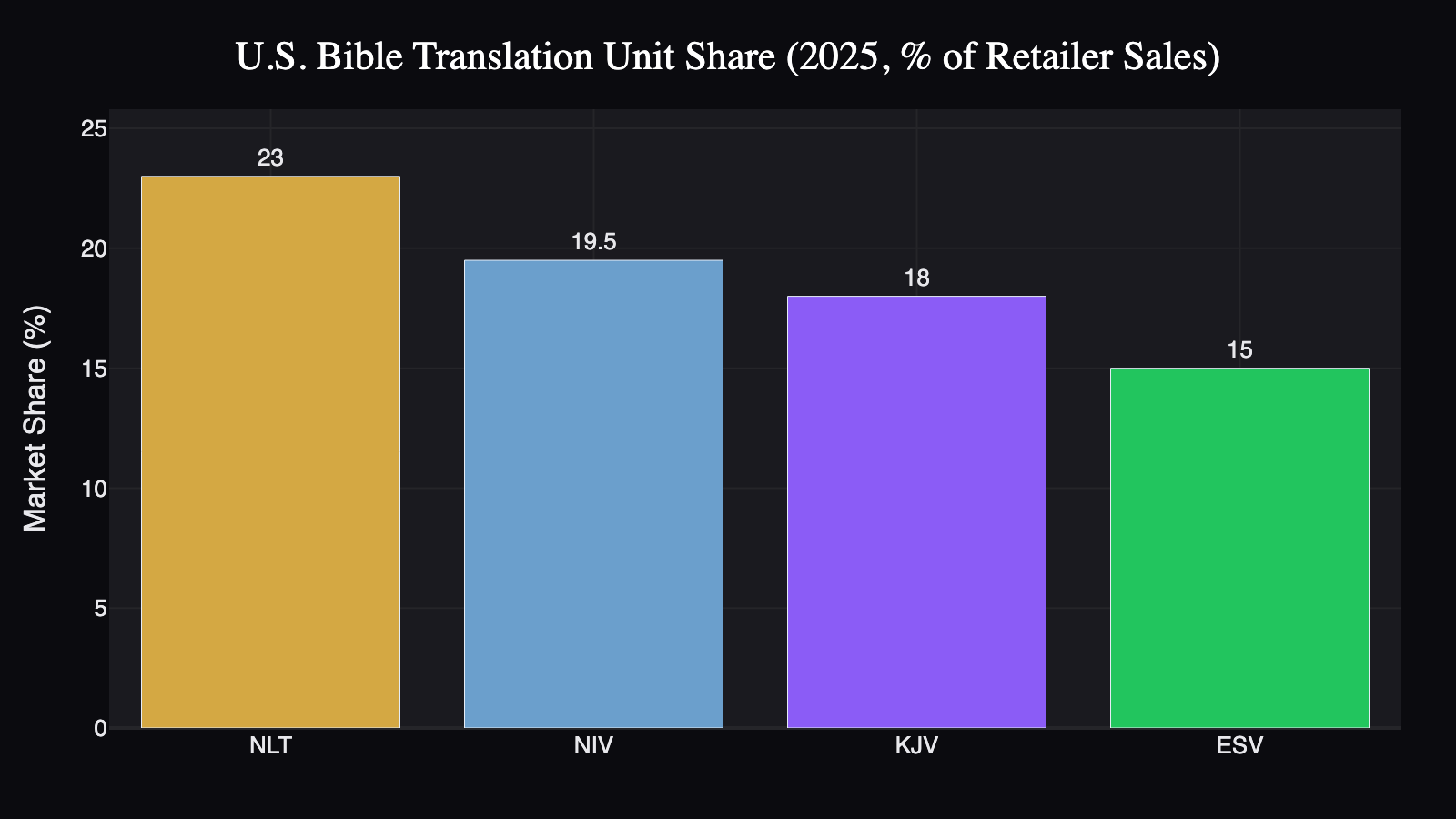
A 2025 Christian retailer survey cited by Lumenology found the NLT leading U.S. unit sales at roughly 23% share, followed by NIV at 19.5%, KJV at 18%, and ESV at 15%. The NIV appears in worship at approximately 70% of U.S. congregations.
For a passage like Jeremiah 29:11, the NLT's "I know the plans I have for you" reads with immediate warmth. If you're preaching from it and want to ground a congregation in the Hebrew word for "plans" (machashavot, conveying thoughts that are developed and purposeful), the NASB or ESV gives you tighter footing. Both are correct; they serve different moments.
How Is Bible Translation Work Changing in 2026?
Bible translation reached a landmark in 2025, when Wycliffe reported that 99% of the world's population can now access at least some Scripture in their own language.
According to the Wycliffe Global Alliance / ProgressBible 2025 Statistics, the numbers tell a remarkable story:
- 7,396 living languages worldwide
- Only 544 remain without any translation project started (down from 985 a year earlier, and over 5,000 in 1999)
- 99% of the world's population has access to at least some portion of Scripture
- 4,100+ texts in 2,444 languages in the Digital Bible Library as of January 2026
- 3,200+ audio Scriptures in 1,800 languages, plus new Braille and sign-language resources
The 66 first-ever translations published in 2025 represent communities reading the Bible in their own tongue for the first time. For English readers, this ongoing global effort matters too: new textual discoveries and interdisciplinary scholarship continuously refine the manuscript base that future English revisions will draw from. The KJV's 54 scholars, appointed by King James I in 1611 as documented by Amazing Bible Timeline, worked from the best available manuscripts of their era. Their modern counterparts have access to thousands more.
How ScriptureVerse Helps You Study Across Translation Differences
ScriptureVerse gives you the cross-reference infrastructure to study any passage in context, letting you trace how a theme connects across the whole Bible before you compare translations.
When translation debates get technical, context usually clarifies more than word-choice arguments alone. Knowing that Isaiah 41:10 in both formal and dynamic translations points back to the covenant language of Deuteronomy helps you interpret it regardless of which Bible you're holding.
ScriptureVerse maps that network visually. Every verse is a node. Every cross-reference is an edge. You can activate the Word Study lens to trace a specific term across the whole canon, or the Typology lens to see how Old Testament shadows find New Testament resolution. That context often settles translation debates before they start.
Whether you prefer the ESV's precision or the NLT's readability, the 340,000+ connections ScriptureVerse has mapped don't change. The structure of Scripture stays consistent across translations, and seeing it visually gives you a framework no single translation debate can displace.
For a deeper look at how modern study platforms compare, see what makes a Bible app good for deep study.
 us-bible-translation-unit-share-2025
Frequently Asked Questions
Q: What is the most popular Bible translation in the United States in 2026?
The NLT leads U.S. unit sales at roughly 23% market share, followed by NIV at 19.5%, KJV at 18%, and ESV at 15%. The NIV remains the most widely used in worship settings, appearing in approximately 70% of U.S. congregations.
Q: Is the KJV still a reliable translation in 2026?
Yes. The KJV was produced by 54 scholars appointed by King James I in 1611 and shaped English-speaking Christianity for over three centuries. Its manuscript base is more limited than modern translations, but its accuracy within its own tradition is not disputed. Many readers use it for liturgy and memorization while consulting modern translations for detailed study.
Q: What is the difference between formal equivalence and dynamic equivalence?
Formal equivalence (word-for-word) attempts the closest possible match to the original language structure, as in the NASB and ESV. Dynamic equivalence (thought-for-thought) translates the intended meaning rather than the literal words, as in the NIV and NLT. Both are legitimate; the choice depends on whether you prioritize textual precision or natural readability.
Q: How do Bible translators decide which manuscripts to use?
Textual critics compare thousands of ancient manuscripts, including papyrus fragments, codices like Codex Sinaiticus, the Dead Sea Scrolls, and the Masoretic Text. The goal is to reconstruct the most reliable original text. Different translation committees weigh these sources differently, which is why versions diverge at the word level on specific passages.
Q: Can reading multiple translations improve Bible study?
Yes. Comparing a formal equivalence translation like the ESV or NASB with a dynamic equivalence translation like the NIV or NLT highlights where translators made interpretive choices and where meaning can be read in more than one way. That comparison often opens the most productive study questions.
Q: What translation is best for a new Christian?
The CSB or NIV are commonly recommended for first-time readers. Both use accessible language without sacrificing accuracy. The NLT is also strong for narrative books and devotional reading. Any of these will serve a new reader well from the first chapter.
Q: How does ScriptureVerse work across different Bible translations?
ScriptureVerse maps cross-references and connections at the canonical level, so its network of 340,000+ links is translation-independent. You bring your preferred translation context to your study, and the visualization shows how a passage connects to the rest of Scripture regardless of which Bible version you use.
Q: Where can I learn more about Bible translations in depth?
The Logos textual criticism primer (August 2025) offers a clear introduction to how manuscript comparison works, accessible to readers without original-language background. For a broader overview of choosing the right version, see Bible Translations Explained: How to Choose the Right One (2026).
Ready to see Scripture's hidden connections? ScriptureVerse visualizes every verse and cross-reference as an interactive cosmos. Start exploring →