Content Bible Studying: Methods, Tools & How to Go Deeper (2026)
Learn the best methods for content Bible studying in 2026 - inductive study, cross-references, AI tools, and how to go from reading to deep Scripture engagement.

Weekly Bible reading among U.S. adults climbed to 42% in late 2025 - up 12 points from a 15-year low in 2024 and the highest rate since 2012, according to Barna Group's research. More people are opening Scripture than at any point in over a decade. The harder question is what happens after the page opens.
Reading and studying are different disciplines. Content Bible studying is the practice of engaging the actual substance of Scripture - its arguments, literary structures, cross-references, and theological threads - with enough attention to understand what a text is saying, not just what it feels like. Most people never cross that line. They read John 3:16 devotionally but never trace how it participates in a canonical argument running from Genesis 3 through Romans 5 and into Revelation 21.
Tools like ScriptureVerse were designed for exactly that gap. It renders the Bible's entire cross-reference network - 31,102 verses, 340,000+ connections - as a navigable 3D cosmos. When you land on a verse, its connections radiate outward. Following them is the point. This guide covers what content Bible studying actually means, which methods go deepest, and which tools in 2026 make serious engagement more accessible than it has ever been.
What Is Content Bible Studying?
Content Bible studying means examining Scripture's actual text - its words, context, structure, and connections - rather than reading for devotional comfort alone.
The distinction matters because most people's default Bible engagement stays devotional: a short passage, a reflection, maybe a prayer. That practice has real value. But content study asks different questions. What genre is this passage? Who wrote it, when, and to whom? How does this paragraph fit the larger argument of the book it comes from? What earlier texts does the author appear to be quoting or echoing? These questions require method, not just intention.
The American Bible Society's State of the Bible 2025 found 41% of U.S. adults - roughly 110 million people - qualified as active Bible users in 2025, with Millennials driving a 29% year-over-year increase in engagement. More people are arriving at the text. Content study gives that arrival staying power.
What Are the Core Methods for Studying Bible Content?
The core methods for studying Bible content range from word-level analysis and inductive observation to panoramic book surveys and multi-book topical tracking across the canon.
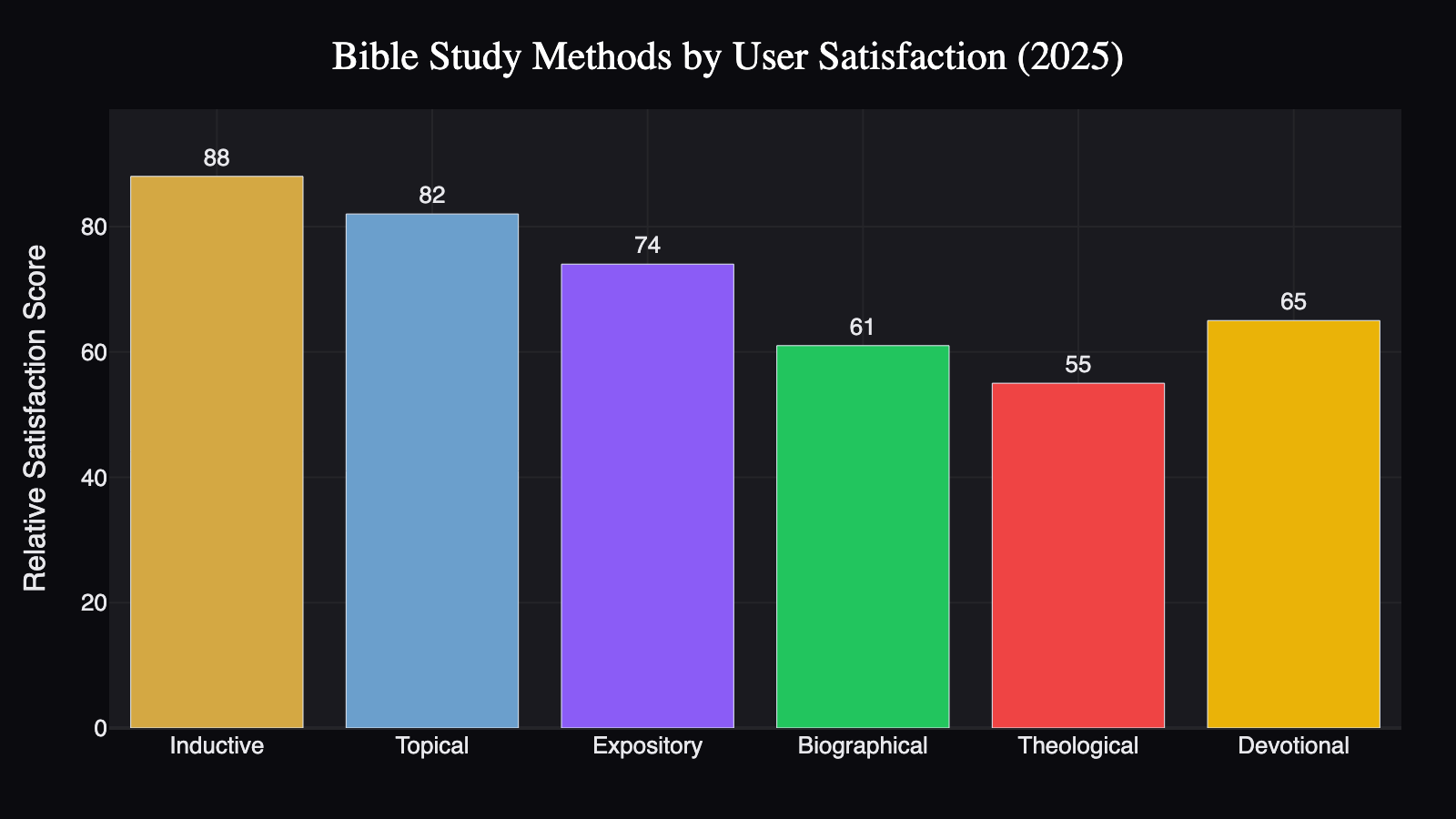
Sanctuary Baptist's 2025 resource guide identifies 12 recognized methods: inductive, deductive, synthetic, analytical, topical, biographical, devotional, historical, theological, practical, comparative, and expository. Each targets a different layer of the text:
- Inductive: Start with the raw text. Observe what it says before deciding what it means.
- Topical: Follow a single theme - like faith or prayer - across multiple books and authors.
- Expository: Work verse-by-verse through a single book to understand its internal logic.
- Biographical: Study a biblical figure across every passage that mentions them.
- Theological: Trace how a doctrine develops from Genesis through Revelation.
Research from the same guide found that resources combining multiple methods showed 55% higher user satisfaction compared to single-approach materials. No single method captures the full texture of any given passage. The most productive readers mix methods deliberately - using inductive observation to anchor a session, then topical cross-referencing to see where that passage sits in the larger argument.
How Does Inductive Bible Study Work?
Inductive Bible study is a three-step method where students begin with the raw text and draw conclusions from it rather than reading conclusions into it.
GotQuestions.org's overview contrasts it with deductive study, which most sermons and topical curricula use. Deductive starts with a conclusion ("grace is sufficient") and finds texts that support it. Inductive starts with a text and asks: what does this actually say?
The three phases in practice:
- Observation - Mark key words, note repeated terms, identify contrasts, and map how the passage fits its literary context. What is the author doing structurally?
- Interpretation - Determine historical and cultural context. Cross-reference parallel passages. Ask what the original audience would have understood before asking what it means to you.
- Application - Establish what this means for your specific life situation. Not just "what is relevant" but "what is mine to do with this?"
InterVarsity Christian Fellowship frames inductive study as inherently communal - a tool for "leading people to discover biblical truth together" rather than a solo lecture format. That framing reflects something real: content study deepens in community because other readers notice what you missed in the observation phase.
BibleStudy.tips' step-by-step guide breaks the observation phase down further into marking key words, noting repetition, identifying contrasts and comparisons, and mapping literary context before moving to interpretation. The specificity matters. Vague observation produces vague interpretation.
Why Do Cross-References Matter for Content Bible Study?
Cross-references matter because no passage in Scripture is self-interpreting - the authors wrote in conversation with prior texts, and tracking those links reveals meaning flat reading misses.
The entire Bible contains over 340,000 cross-reference connections. Romans 8:28 - "all things work together for good" - pulls threads from Genesis 50, Psalm 105, and Isaiah 45 into a single theological claim. Reading it in isolation gives you the promise. Tracing its cross-references gives you the argument behind the promise.
This is where visualization changes content study at a structural level. When you're examining Matthew 11:28 ("Come to me, all who are weary") in ScriptureVerse, the galaxy view shows every connected verse radiating outward - Exodus 33, Isaiah 40, Jeremiah 31 - and you can follow any thread without losing your place in the original passage.
That is a different experience than following a chain-reference Bible by hand, and the difference compounds. Patterns emerge across the canon that no single-session reading would surface. For a comparison of how different platforms handle this depth, see What Makes a Bible App Good for Deep Study? (2026).
What Bible Study Tools Work Best in 2026?
The best Bible study tools in 2026 combine translation access, original-language resources, and cross-reference depth without requiring expensive desktop software licenses.
| Tool | Best For | Cost |
|---|---|---|
| Blue Letter Bible | Greek/Hebrew word studies, Strong's, free commentaries | Free |
| Bible Hub | Quick multi-translation comparison | Free |
| Logos Bible Software | Academic library depth | Paid (expensive) |
| ScriptureVerse | Cross-reference visualization, AI teaching | Subscription |
| BibleGateway | Translation variety, reading plans | Free/Paid |
Blue Letter Bible's study resources remain one of the strongest free offerings available: Strong's Concordance, Greek and Hebrew lexicons, interlinear views, and major commentaries (Matthew Henry, Treasury of Scripture Knowledge, Spurgeon) - all without a paywall. Gene Whitehead's 2026 guide recommends it specifically for original-language word studies, paired with Bible Hub for fast multi-translation parallel views.
For content study, the question is not which tool has the most features. It is which tool matches the depth of inquiry you are bringing. For a side-by-side breakdown of the leading platforms, the YouVersion vs Blue Letter Bible vs ScriptureVerse comparison covers the key tradeoffs.
Pro Tip: Seek First Resources' 2026 guide puts it plainly: "The goal of study is transformation, not just information." The best tool is the one that keeps you returning to the text rather than building a collection of insights about it.
How Is AI Changing Content Bible Study?
AI is changing content Bible study by providing on-demand scholarly interpretation, contextual connections, and personalized teaching that was previously locked behind formal training or expensive software.
Barna Group's 2026 research found that roughly 4 in 10 practicing Christians say AI has helped them with prayer, Bible study, or spiritual growth. Among Gen Z and Millennials, nearly 2 in 5 consider spiritual advice from AI as trustworthy as advice from a pastor. That shift reflects both growing comfort with AI and a shortage of trained teachers who can answer questions at the moment the text raises them.
ScriptureVerse's AI Teacher is built specifically for content study. It operates in five modes (Explore, Devotional, Academic, Pastoral, Socratic) and is denomination-aware across Catholic, Protestant, Orthodox, and other traditions. Critically, it sees the same visualization you are looking at. When you're examining Proverbs 3:5 in the Word Study lens, the Teacher knows which lens is active and which node is focused - answers are shaped by where you are in the text, not generated generically.
The same Barna data found 41% of pastors use AI for Bible study preparation, while only 12% feel comfortable teaching about AI from the pulpit. The tools are ahead of the conversation about them.
What Is the Right Pace for Deep Content Bible Study?
Slower and more attentive study beats faster and broader coverage for most people, because depth in a single passage compounds in ways that speed cannot replicate. Whatever sustains your consistent return to the text is the right pace.
Many study programs push a chapter per day or a book per week. That works for survey reading. For content study - the kind that builds lasting interpretation - depth outperforms speed. A few practical principles:
- Study a passage until you can state its main point in one sentence. If you cannot, the observation phase is not finished.
- Let a single word anchor a session. Pick one theologically loaded term from the passage - grace, wisdom, peace - and trace it across two or three related texts before moving on.
- Return to the same passage multiple times. Inductive study gains depth from re-reading, not just the first pass.
- Take notes in your own words. The act of paraphrase forces you to check whether you actually understood the text or just recognized it.
- Cross-reference before reaching for a commentary. Let Scripture interpret Scripture first.
The Barna research showing Gen Z and Millennials driving a Bible reading comeback is encouraging. The challenge for this generation is not access to Scripture - it is developing habits that move from reading to content engagement. For help choosing a translation that supports serious study, the Bible Translations Guide: Types, Accuracy & How to Choose (2026) covers the key differences.
 study-methods-satisfaction
Frequently Asked Questions
Q: What does "content Bible studying" mean?
Content Bible studying is the practice of engaging the actual text of Scripture - its words, structure, cross-references, and theological development - rather than reading it purely for devotional reflection. It uses defined methods like inductive study, word study, and expository analysis to understand what the text says and why it says it that way.
Q: What is the difference between inductive and deductive Bible study?
Inductive study starts with the raw text and draws conclusions from it. Deductive study starts with a theological conclusion and finds supporting texts. Inductive is generally better for content study because it holds the reader accountable to what the text actually says before moving to interpretation.
Q: Do I need to know Greek or Hebrew to study Bible content seriously?
No. Tools like Blue Letter Bible give English readers access to original-language word meanings through Strong's Concordance and lexicons without requiring formal language study. Knowing that a Greek word carries a range of meanings - or that the same term appears in three nearby passages - is available to anyone using free tools.
Q: How do cross-references deepen content Bible study?
Cross-references reveal the network of connections the biblical authors built into the text. Tracing them shows how a single passage participates in larger canonical arguments, which prevents reading any verse in isolation. A passage like Isaiah 41:10 reads differently once you have traced its echo through the Psalms and into Paul's letters.
Q: How long should a content Bible study session be?
Most study guides recommend 20 to 45 minutes of focused content study. The key is working through a complete unit - a paragraph, a passage, or a single argument - rather than stopping at an arbitrary time limit. Depth matters more than duration.
Q: Is AI a reliable tool for serious Bible study?
Quality varies significantly. Barna's 2026 data found 41% of pastors use AI for Bible study preparation. The most reliable AI tools for this purpose are built specifically for biblical content - denomination-aware, grounded in the text, and clear about the difference between textual observation and theological interpretation.
Q: What is the best free resource for content Bible study in 2026?
Blue Letter Bible remains one of the strongest free options: Strong's Concordance, Greek and Hebrew lexicons, interlinear views, and major commentaries (Matthew Henry, Treasury of Scripture Knowledge, Spurgeon) - all without a paywall or any required account. Bible Hub adds fast parallel translation views.
Q: How does visualization help with content Bible study?
Visualization makes the cross-reference network navigable rather than theoretical. Seeing 340,000 connections rendered as a 3D galaxy allows you to follow a theological thread across the entire canon in a way that flat text search cannot replicate - and to see which verses cluster together, which are isolated, and where the densest networks of meaning form.
Ready to see Scripture's hidden connections? ScriptureVerse visualizes every verse and cross-reference as an interactive cosmos. Start exploring →