What Does the Bible Say About Joy? Key Verses & Insights (2026)
Discover what the Bible teaches about joy, from Hebrew simchah to Greek chara, with key verses from Psalm 16:11, Philippians 4:4, and James 1:2-4. Updated 2026.

Looking at the post, I'll find 1-3 spots where existing posts connect naturally to what's already written — without adding any sentences.
Three clear fits:
- "cross-reference network" in the key verses section - directly relevant to the cross-references explainer post
- "Galatians 5:22" in the fruit of the Spirit section - links naturally to the commentary post on that exact passage
- "strength" in the Nehemiah 8:10 prose quote - the strength post covers that verse's core claim directly
Here is the post with those three links added:
Joy is one of the most mentioned emotions in the Bible, and also one of the most misunderstood. Many people treat it as a synonym for happiness, assuming it rises and falls with circumstances. Scripture draws a sharper line.
That distinction sits at the center of some of Scripture's most recognizable passages. From David's "fullness of joy" in Psalm 16:11 to Paul writing "rejoice always" from a Roman prison cell, the Bible returns again and again to a joy that does not depend on outcomes. If you want to explore how these passages connect across both Testaments, ScriptureVerse maps all 31,102 Bible verses and their 340,000+ cross-references as an interactive cosmos, making it easy to trace how joy threads through Scripture as a single sustained theme.
Interest in these questions is growing. According to Barna Group's 2025 research, weekly Bible reading among U.S. adults has rebounded to 42%, up 12 points from a 25-year low in 2024, with Gen Z leading the rebound by 19 points in a single year. People are coming back to the text with fresh questions - including this one.
What Does the Bible Mean by "Joy"?
The Bible defines joy as a Spirit-produced capacity rooted in God's grace, distinct from mood or circumstance, and present even in the middle of trials.
The word carries that meaning at the root level. In the New Testament, joy is most often translated from the Greek chara, and its verb form chairo (rejoice). Scholars have noted that chara shares the root char- with charis, the Greek word for grace. That etymology is not coincidental. Biblical joy is the soul's recognition that grace is real, that God has acted on your behalf, and that nothing can undo it.
One theological treatment describes it as "the emotional dimension of a life that is both going well and being lived well" - but with the critical qualifier that its source is covenantal, the "signature of a spirit that is no longer in bondage to its own disordered appetites." That is a different category than feeling good.
What Are the Most Important Bible Verses About Joy?
Scripture's key joy verses run from Nehemiah 8:10 through Philippians 4:4 and consistently locate joy in God's presence, not in favorable circumstances.
Here are ten passages that together give the fullest picture of what Scripture teaches:
| Verse | Theme |
|---|---|
| Psalm 16:11 | Joy in God's presence: "fullness of joy" at his right hand |
| Nehemiah 8:10 | Joy as strength: "the joy of the Lord is your strength" |
| Isaiah 35:10 | Eschatological joy: everlasting joy on the redeemed |
| John 15:11 | Jesus's own joy shared fully with his disciples |
| Romans 15:13 | God as the source of joy and peace through the Spirit |
| Galatians 5:22 | Joy as the second fruit of the Spirit |
| Philippians 4:4 | The command to rejoice, stated twice in one verse |
| James 1:2-4 | Joy in trials as the path to proven character |
| Psalm 30:5 | "Weeping may tarry for the night, but joy comes with the morning" |
| John 16:22 | A joy "no one will take from you" |
You can trace how many of these passages cross-reference each other - Psalm 16:11 connecting to John 15:11, and Philippians 4:4 echoing Romans 15:13 - using ScriptureVerse's visualization tools. The cross-reference network reveals a theology of joy that builds across centuries and literary genres.
How Is Joy Different From Happiness?
Biblical joy differs from happiness in that happiness depends on external circumstances, while joy is a Spirit-produced state that persists through grief, imprisonment, and loss.
Happiness is reactive. When circumstances improve, it rises. When they deteriorate, it falls with them.
Joy, by biblical definition, operates at a different layer. Paul writes "Rejoice in the Lord always" in Philippians 4:4 from a cell, under guard, facing potential execution. The command to rejoice is not written around his circumstances. It is written straight through them.
Several features separate biblical joy from ordinary happiness:
- It has a fixed source - God's character and covenant faithfulness - rather than shifting with events
- It can be commanded, which would make no sense if it were simply an emotion
- It co-exists with grief, as Paul demonstrates consistently across his letters
- It is directional: it grows through practice, trial, and deepened trust in God
The distinction matters practically. A faith built on happiness is fragile. A faith built on biblical joy has what James 1 calls the "testing of faith" built into it. Trials do not disprove joy. According to James, they prove it.
What Does the Old Testament Say About Joy?
The Old Testament describes joy through at least seven Hebrew words, most prominently simchah, and ties it directly to God's presence, his covenant faithfulness, and communal worship.
Hebrew has a richer vocabulary for joy than English. The main terms include:
- Simchah: gladness, often linked to festivals and worship, used throughout Psalms and Ecclesiastes
- Giyl: joyful leaping or spinning, used when the psalmists cannot contain their response to God
- Sason: exultation, often tied to salvation events
- Rinnah: a ringing cry of joy, used in worship contexts
- Masos: delight and exultation, sometimes with the sense of God himself delighting in his people
Nehemiah 8:10 uses simchah in a striking setting. The people have returned from exile, the Law is being read aloud publicly, and many are weeping at what they have heard. Nehemiah's instruction is to stop grieving and celebrate, "for the joy of the Lord is your strength." Joy there is not a denial of hard history. It is the appropriate response to restored covenant relationship.
Psalm 16:11 reaches the theological summit of Old Testament joy: "In your presence there is fullness of joy; at your right hand are pleasures forevermore." David is not describing an emotional high. He is describing the nature of God's presence itself.
For readers who want to trace the parallel strand running alongside joy, our post on what the Bible says about hope covers the same literature from a closely connected angle.
What Does the New Testament Say About Joy?
The New Testament records joy (chara) 59 times, and the word shares its root with charis, meaning grace, linking joy directly to God's unmerited gift.
The NT account of joy is inseparable from Jesus. In John 15:11, he tells the disciples: "These things I have spoken to you, that my joy may be in you, and that your joy may be full." Jesus does not promise them a joy they must manufacture. He offers them a share in his own.
"These things I have spoken to you, that my joy may be in you, and that your joy may be full." - John 15:11 (ESV)
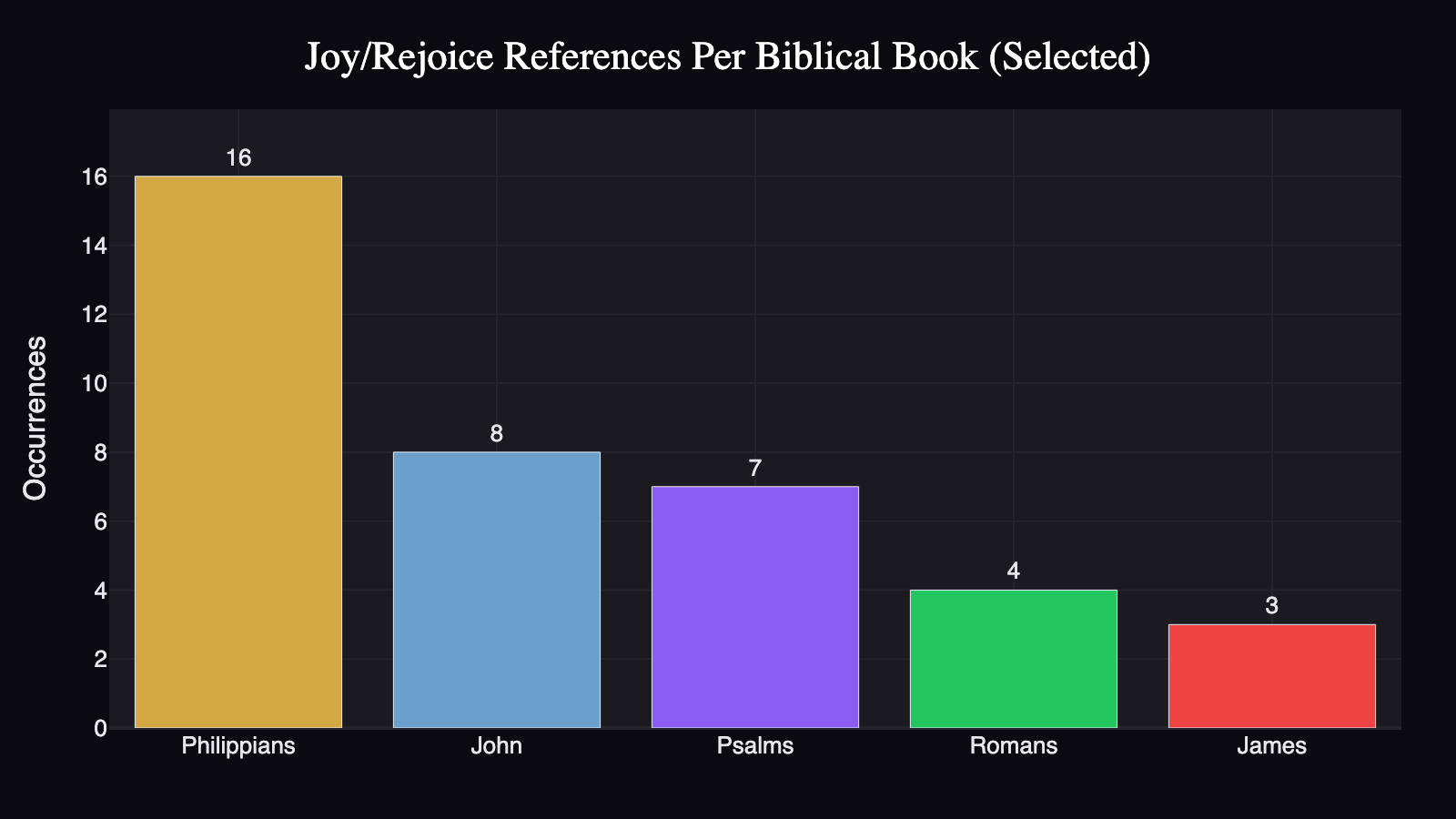
Paul carries this forward with force. In Philippians, he uses the joy and rejoice word cluster more than 16 times in four short chapters - a concentration that becomes even more striking knowing he was writing under house arrest. The command in Philippians 4:4 to "Rejoice in the Lord always" is not naive optimism. It is a theological claim about where joy comes from and what can or cannot remove it.
Romans 15:13 frames the source plainly: "May the God of hope fill you with all joy and peace in believing, so that by the power of the Holy Spirit you may abound in hope." Joy and hope are linked here as gifts from the same source, produced by the same Spirit.
Can Joy Coexist With Suffering and Trials?
Biblical joy can coexist with suffering because James 1:2-4 and Philippians 4:4 both command rejoicing in difficult circumstances, locating joy in God's faithfulness rather than in relief.
This is one of the most practically important claims in the New Testament. If joy required good circumstances, it would be unavailable to most of the world in most of history. But Scripture presents joy as something that does not wait for the storm to pass.
James opens his letter by telling scattered, persecuted believers to "count it all joy" when they face trials. The Greek verb for "count" (hegeomai) is an accounting term - a deliberate reckoning, not a forced smile. He is not telling them to pretend the trials are good. He is telling them to accurately assess what the trials are producing: steadfastness, proven character, completeness.
Romans 8:28 adds the theological foundation underneath that command: "And we know that for those who love God all things work together for good." That certainty - not optimism, but covenantal certainty - is part of what makes joy possible in loss.
Paul's own witness is the strongest case. Read Philippians with the Roman prison context in mind, and the joy threaded through it reads as firsthand testimony, not theory.
If you are tracing how joy and suffering interact across Scripture, our post on what the Bible says about suffering covers the theological framework in detail.
How Does Joy Connect to the Fruit of the Spirit?
Joy is listed second in the fruit of the Spirit in Galatians 5:22, immediately after love, identifying it as evidence of the Spirit's work rather than personal effort.
The placement matters. Paul lists joy right after love and before peace, patience, kindness, goodness, faithfulness, gentleness, and self-control. The singular "fruit" - not "fruits" - signals that these qualities are not separate items to achieve one by one. They grow together as the natural result of the Spirit's presence.
This means joy is not something you produce through willpower or positive thinking. It is what grows when the Spirit is active in a life submitted to God. You cultivate the conditions: regular Scripture, prayer, worship, honest community.
That cluster - joy alongside peace and grace - describes a life shaped from the inside out. Where the Spirit is working, joy is one of the diagnostic signs.
How Can I Experience More Biblical Joy?
Experiencing more joy in your faith, according to Scripture, begins with redirecting your attention from circumstances to God's promises, his presence, and the community of believers.
Practically, Scripture points to a clear sequence:
- Return to the Word. Nehemiah 8 shows a whole community experiencing joy when the Law is read aloud. Joy and Scripture are consistently linked in both Testaments.
- Pray with thanksgiving. Philippians 4:6-7 connects peace and joy directly to prayer offered with gratitude - the habit of naming what is good even in hard seasons.
- Worship with others. Old Testament joy is nearly always communal. Simchah appears repeatedly in festival and gathered worship contexts. Joy grows in community.
- Sit with the Psalms. Psalm 16 and Psalm 30 both model an honest arc: grief and lament, then a deliberate turn toward trust. The Psalms do not require you to skip the hard parts to arrive at joy.
- Expect trials to refine. James 1:2-4 reframes suffering not as an interruption to joy but as the mechanism by which character - and therefore mature, tested joy - develops.
Research from Barna Group (2026) finds that roughly 4 in 10 practicing Christians say AI has helped them with Bible study or spiritual growth. Tools like ScriptureVerse can surface the cross-reference network around a verse like John 15:11, showing how that single promise is supported and illustrated across dozens of connected passages in both Testaments.
 joy-references-by-book
Frequently Asked Questions
Q: Is joy a fruit of the Spirit or a command?
Both. Galatians 5:22 lists joy as a fruit of the Spirit, something produced by the Spirit's presence. Philippians 4:4 commands believers to rejoice. Scripture holds both without contradiction: the Spirit produces the capacity, and believers are called to exercise it deliberately.
Q: What is the difference between joy and peace in the Bible?
Joy and peace appear together in Romans 15:13 and Galatians 5:22 because they are related but distinct. Joy is an active response to God's grace and goodness. Peace is the settled state of one who trusts God's sovereignty. You can have joy in the middle of turmoil; peace is the quiet that underlies it.
Q: Why could Paul say "rejoice always" while in prison?
Paul's command in Philippians 4:4 carries weight precisely because he wrote it under arrest. His argument throughout Philippians is that joy flows from Christ, not from external conditions. If the source is Christ, then no prison, no threat, and no loss can remove the source.
Q: What Hebrew word is most often translated as "joy"?
The most common Hebrew word for joy is simchah, which appears frequently in the Psalms and across wisdom literature. It refers to gladness often tied to worship, festivals, and covenant relationship. Nehemiah 8:10 ("the joy of the Lord is your strength") uses simchah.
Q: Does the Bible say God experiences joy?
Yes. Zephaniah 3:17 says God "will rejoice over you with gladness" and "exult over you with loud singing." The same Hebrew vocabulary used for human joy appears here applied to God's own response to his people. Joy is not just something God gives. It is something he shares.
Q: What is the relationship between joy and gratitude in the Bible?
Gratitude and joy are closely linked in Scripture. Philippians 4:6 tells believers to come to God "with thanksgiving" and promises the peace of God in return. The habit of naming what is good redirects attention to what God has done - which Scripture consistently frames as the wellspring of joy. Our post on what the Bible says about gratitude explores this connection further.
Q: How many times does the Bible mention joy?
The word "joy" appears over 200 times in the ESV, and the related verb "rejoice" adds hundreds more. In the Greek New Testament alone, chara (joy) appears 59 times and chairo (rejoice) 74 more times. Paul uses the joy and rejoice word cluster more than 16 times in Philippians alone.
Ready to see Scripture's hidden connections? ScriptureVerse visualizes every verse and cross-reference as an interactive cosmos. Start exploring →