Accordance vs Logos vs ScriptureVerse: In-Depth Comparison for Serious Students (2026)
Compare Accordance, Logos, and ScriptureVerse for serious Bible study in 2026 - pricing, original-language tools, AI features, and which platform fits your goals.

Serious Bible students have always faced the same tension: the most powerful study tools demand the steepest investment - in money, time, and learning curve. For decades, that debate has centered on two names: Accordance and Logos. Both are purpose-built for seminarians, pastors, and scholars who need deep original-language tools and large library collections. Both have devoted followings. And both carry enough depth that most students barely scratch the surface of what they've purchased.
But 2026 looks different. Weekly Bible reading among U.S. adults rebounded to 42% in 2025, up 12 points from a 25-year low - and the students driving that resurgence aren't just looking for more books in a digital library. They want tools that help them see Scripture, ask questions conversationally, and track how their understanding develops over time.
That's where ScriptureVerse enters the picture. While Accordance and Logos organize Scripture as layered libraries of texts and commentaries, ScriptureVerse renders all 31,102 verses and 340,000+ cross-references as a navigable 3D cosmos - with an AI teacher that sees your visualization context and guides you through it. For a direct head-to-head, see the full ScriptureVerse vs Logos Bible Software comparison.
This article breaks down what each platform actually does best, where each falls short, and which belongs in your study workflow in 2026.
What Are Accordance and Logos - and Who Are They Built For?
Accordance and Logos are desktop-focused Bible study platforms built for seminarians, pastors, and scholars who need deep original-language tools and large library collections.
Accordance (made by OakTree Software) has historically been the Mac-first choice, with a reputation for a cleaner, faster interface particularly suited to Greek and Hebrew work. Logos (made by Faithlife) runs on every major platform and has built the largest integrated theological library in the world - with tens of thousands of books, commentaries, and journals available through its ecosystem.
Both platforms have been standard seminary recommendations for over two decades. Duke University's Divinity Library specifically names Accordance in its official Hebrew and Greek word study guide, alongside a recommended four-step workflow: concordance → original-language concordance → lexicon → theological dictionaries.
How Do Accordance and Logos Compare on Pricing?
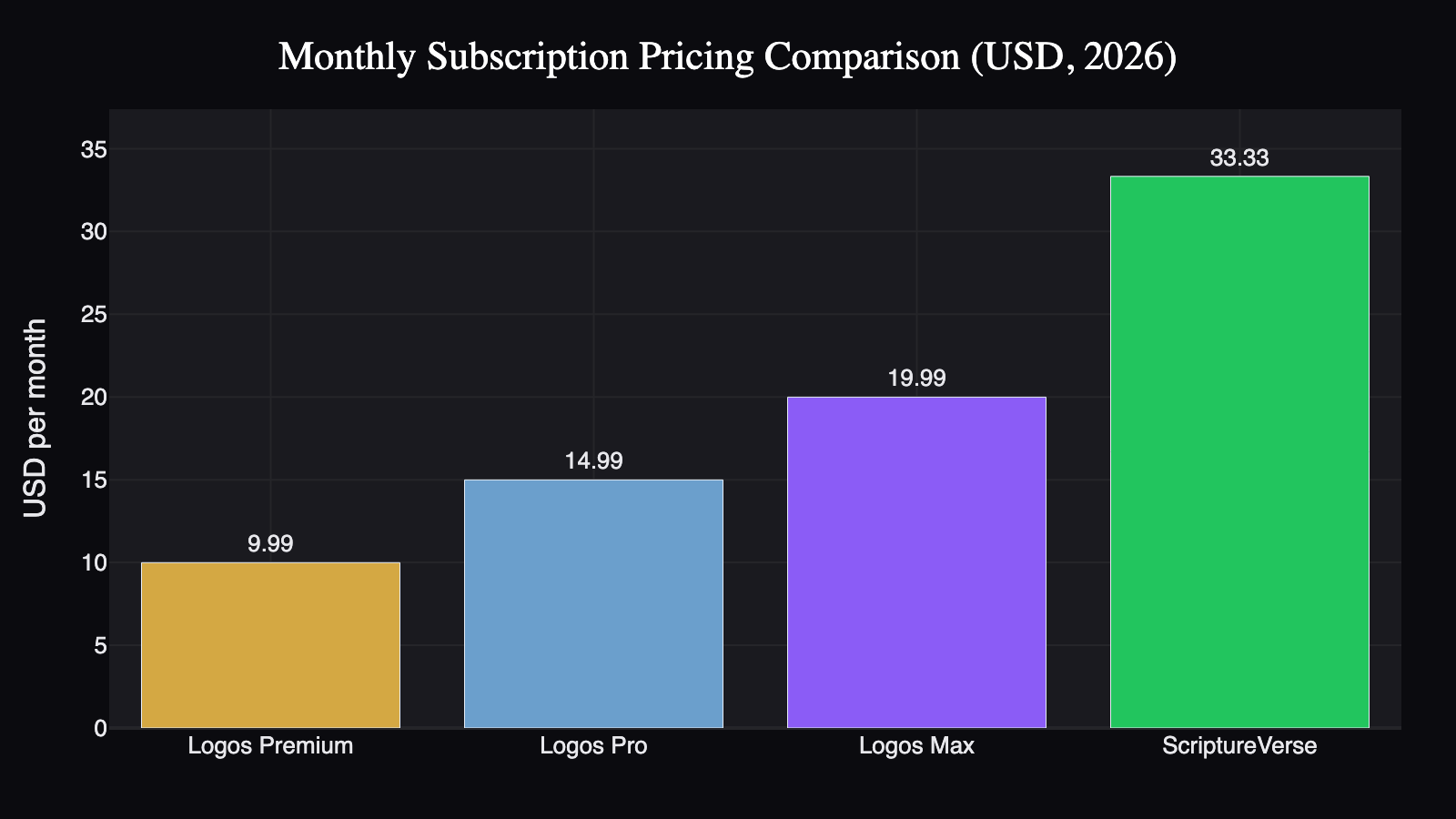
Logos uses a tiered subscription from $9.99 to $19.99 per month, while Accordance sells one-time collections with student pricing starting around $449.
Here's a direct comparison across all three platforms:
| Feature | Accordance | Logos | ScriptureVerse |
|---|---|---|---|
| Pricing model | One-time purchase | Subscription | Subscription |
| Entry price | ~$449 (student, Discoverer collection) | $9.99/mo (Premium) | $33.33/mo ($333/yr) |
| Free trial | 90 days | 30 days | 7-day trial |
| Original languages | Excellent | Very good | - |
| AI features | Minimal | AI Summarize, Factbook | AI Teacher (5 modes, memory-aware) |
| Visualization | None | Limited | Full 3D cosmos (10 lenses) |
| Cross-reference network | Strong | Strong | 340,000+ interactive edges |
| Platform | Mac/iOS-first | All platforms | Browser (web) |
| Best for | Language scholars | Pastors, seminarians | Visual learners, AI-native students |
One important Logos detail worth noting: after 24 consecutive months of subscription, you earn a "Legacy Fallback License" - offline access to your library remains even after cancellation. That's a meaningful long-term hedge against the subscription model's usual risk.
What Does Accordance Do Best?
Accordance excels at original-language study, offering a clean Hebrew and Greek interface that researchers at institutions like Duke University consistently recommend for rigorous word-study workflows.
Key strengths:
- Clean Hebrew/Greek interface - Many scholars prefer Accordance's original-language tools for their visual clarity and search precision
- One-time purchase model - No ongoing subscription; collections like the Greek & Hebrew Discoverer (~$449 with student pricing) offer strong value vs. equivalent Logos content
- Mac-native performance - Historically faster and more responsive on Apple hardware
- Precise grammatical search - Morphological filtering and syntax search remain best-in-class for exegetical work
A real-user comparison from 2025 found the Accordance student-priced collection to be significantly more accessible than comparable Logos researcher packages, which can run close to $3,300. For students primarily focused on original-language exegesis, Accordance consistently wins on value.
One gap: Accordance has been slow to integrate meaningful AI features, and its visualization capabilities are essentially nonexistent. If you want to trace how a concept like wisdom ripples across the entire biblical canon - from Proverbs through James - you'll be doing that work manually.
What Does Logos Do Best?
Logos excels at library aggregation, AI-assisted research, and sermon preparation, making it the dominant choice among pastors, small group leaders, and ministry students who need breadth over depth.
Key strengths:
- Largest theological library - Tens of thousands of books, commentaries, and academic journals in one ecosystem
- AI Summarize and Factbook - Instant lookup for people, places, and themes across your entire library; reviewed positively by Denver Seminary's Dr. William Klein in November 2024
- Multi-platform - Windows, Mac, iOS, Android, and web
- Library savings - As buyers guide author Nick Stapleton notes in his 2026 guide, Logos libraries save users approximately 90% compared to purchasing books individually
- Built-in language courses - Mobile Ed Greek and Hebrew courses use reverse interlinears so students can do language work without memorizing full paradigms
The Logos subscription model (Premium at $9.99/mo, Pro at $14.99/mo, Max at $19.99/mo - all with 30-day free trials) has matured significantly. Continuous delivery means new features arrive as soon as they're ready rather than bundled into major version releases.
The weakness: the depth of the library can become noise. Logos surfaces a lot - and less experienced students frequently report feeling overwhelmed by the sheer number of panels, workflows, and resource types to navigate.
Where Does ScriptureVerse Fit In for Serious Students?
ScriptureVerse offers a third approach - visualizing all 31,102 Bible verses and 340,000+ cross-references as an interactive cosmos, with an AI teacher that studies alongside you.
Rather than asking "which commentary should I open," ScriptureVerse asks: what does the entire network of Scripture look like from this verse? When you open John 3:16, you don't just see the verse - you see its cross-reference neighborhood, the thematic chains that connect it to Romans 8:28, and the typological threads running back through Isaiah. Themes like faith, salvation, forgiveness, joy, strength, and money emerge as visible clusters in the data, not just categories in a search box.
The AI Teacher is the other differentiator. It's not a chatbot bolted onto a search engine - it sees which visualization lens you're using, which node is focused, and responds with that context. It remembers your denomination, your ongoing questions, and where you left off. Five teaching modes (Explore, Devotional, Academic, Pastoral, Socratic) let you set the register for any session.
ScriptureVerse complements Accordance or Logos rather than replacing them - it doesn't include lexicons, large commentary libraries, or original-language morphology search. But for AI-guided discovery and visual cross-reference exploration, it fills a gap neither legacy platform has addressed. Students looking for other options in this space can also explore the 7 Best Accordance Alternatives for Bible Study in 2026.
Which Platform Should You Choose in 2026?
Your best platform depends on whether you prioritize original-language depth (Accordance), library breadth and AI research (Logos), or visual Bible exploration with an AI guide (ScriptureVerse).
Use this decision guide:
- Choose Accordance if you're a language-focused student or scholar who prioritizes Hebrew/Greek work, prefers a one-time purchase, and works primarily on Mac/iOS
- Choose Logos if you're a pastor, small group leader, or seminarian who needs sermon prep tools, wants the largest theological library, and values AI-assisted research across thousands of sources
- Choose ScriptureVerse if you're a visual learner, want AI that understands your actual study context, or want to explore Scripture's cross-reference network as a navigable system - not just a reference tool
- Combine Logos + ScriptureVerse if you want deep library resources and a visual AI-guided layer - many serious students are finding this pairing gives them both depth and discovery
- Try all three free trials first - Accordance offers 90 days, Logos offers 30 days, and ScriptureVerse offers a 7-day trial so you can test before committing
The American Bible Society's State of the Bible 2025 found that 41% of Americans qualify as "Bible Users" - and two-thirds of them now access Scripture digitally. The tools you choose shape how deeply you can engage with the text.
What Do Scholars and Students Say About These Platforms?
Real users consistently praise Accordance for its clean original-language interface and Logos for its vast library savings, but report steep learning curves on both platforms.
Pro Tip: If you're new to either platform, budget real time for onboarding. Both Accordance and Logos have significant depth - but that depth is only useful once you've learned the workflows. ScriptureVerse was designed with a shorter path to insight: load the galaxy, click a verse, ask the AI a question.
The learning-curve friction is documented. A 2025 user comparison noted that both platforms suffer from "unclear pricing" and complex collection structures that intimidate new buyers. Logos addresses this through its Mobile Ed language courses and continuous feature delivery. Accordance addresses it through a cleaner UI - but still assumes significant prior knowledge of biblical scholarship.
For students exploring how AI is reshaping serious Bible study, the best AI Bible study tools in 2026 guide covers how the landscape has shifted beyond legacy desktop software.
 logos-scriptureverse-monthly-pricing-2026
Frequently Asked Questions
Q: Is Accordance or Logos better for seminary students?
Accordance is typically stronger for students focused on original-language exegesis, while Logos excels at sermon preparation, commentary access, and general theological research. Many seminary programs recommend both, depending on your academic track.
Q: How much does Logos Bible Software cost in 2026?
Logos offers three subscription tiers: Premium at $9.99/month, Pro at $14.99/month, and Max at $19.99/month - with annual billing reducing those to $8.33, $12.50, and $16.67/month respectively. All tiers include a 30-day free trial.
Q: What is the main advantage of Accordance over Logos?
Accordance's primary advantages are its cleaner Hebrew and Greek interface and its one-time purchase model. For language-intensive scholarship, many users find Accordance's original-language tools faster and more precise than Logos's equivalent features.
Q: Can ScriptureVerse replace Accordance or Logos?
ScriptureVerse is not a direct replacement for either - it doesn't include lexicons, large commentary libraries, or original-language morphology search. It excels at visual cross-reference exploration and AI-guided teaching, making it a strong complement to either platform rather than a substitute.
Q: Does Logos work offline after you cancel?
After 24 consecutive months of subscription, Logos users receive a "Legacy Fallback License" that allows offline access to their library even after cancellation. Standard subscriptions also include offline access to downloaded content while active.
Q: What makes ScriptureVerse different from Logos or Accordance?
ScriptureVerse visualizes the entire Bible as an interactive 3D network - 31,102 verses connected by 340,000+ cross-reference edges across 10 visualization lenses. Its AI Teacher sees your visualization context and responds to your actual study session, unlike general-purpose search AI or chatbot add-ons.
Q: Which Bible study tool is best for visual learners?
ScriptureVerse is the strongest option for visual learners, offering a 3D cosmos view of all biblical cross-references, 10 visualization lenses (including Characters, Geography, Timeline, and Typology), and a contextual AI teacher that guides exploration in real time.
Q: Is there a free version of Accordance or Logos?
Accordance offers a 90-day free trial with access to core features; Logos offers a 30-day free trial. Neither has a permanent free tier for full functionality. ScriptureVerse offers a 7-day trial on first subscription.
Ready to see Scripture's hidden connections? ScriptureVerse visualizes every verse and cross-reference as an interactive cosmos. Start exploring →